


Fig. 1.
Download original image
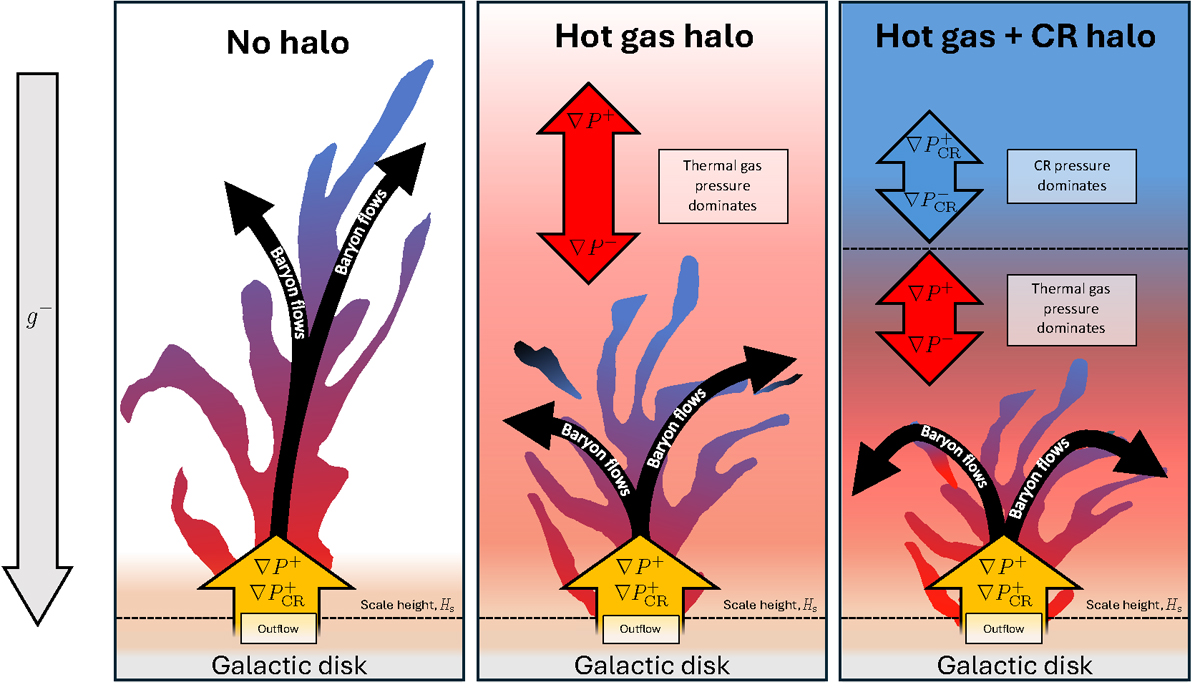
Schematic of the structure of a starburst-driven outflow embedded in a galactic halo, propelled by thermal gas pressure and/or non-thermal CR pressure. The scale height of the warm ISM is indicated. All galaxies are embedded in a gravitational potential, g, which opposes the outflow. Superscripts + and − on quantities indicate whether each term contributes to or opposes the outflow, respectively. Left: In the absence of a substantial gas halo, outflowing gas is unconfined, allowing it to escape beyond the galaxy ecosystem against the galaxy’s gravitational potential. Center: As the galaxy builds up its stellar mass, feedback processes form a hot gas halo that suppresses the outflow, promoting baryonic recycling and enriching the CGM (see Ferrara et al. 2005; Shin et al. 2021). Right: When CRs are supplied to the halo, they accumulate over time, introducing a non-thermal halo component. Since non-thermal CR pressure gradients operate over larger length scales than thermal pressure gradients, an outflow erupting into the galaxy halo encounters distinct layers where thermally dominated and CR-dominated pressure gradients hinder its development.
Current usage metrics show cumulative count of Article Views (full-text article views including HTML views, PDF and ePub downloads, according to the available data) and Abstracts Views on Vision4Press platform.
Data correspond to usage on the plateform after 2015. The current usage metrics is available 48-96 hours after online publication and is updated daily on week days.
Initial download of the metrics may take a while.