


Fig. A.1.
Download original image
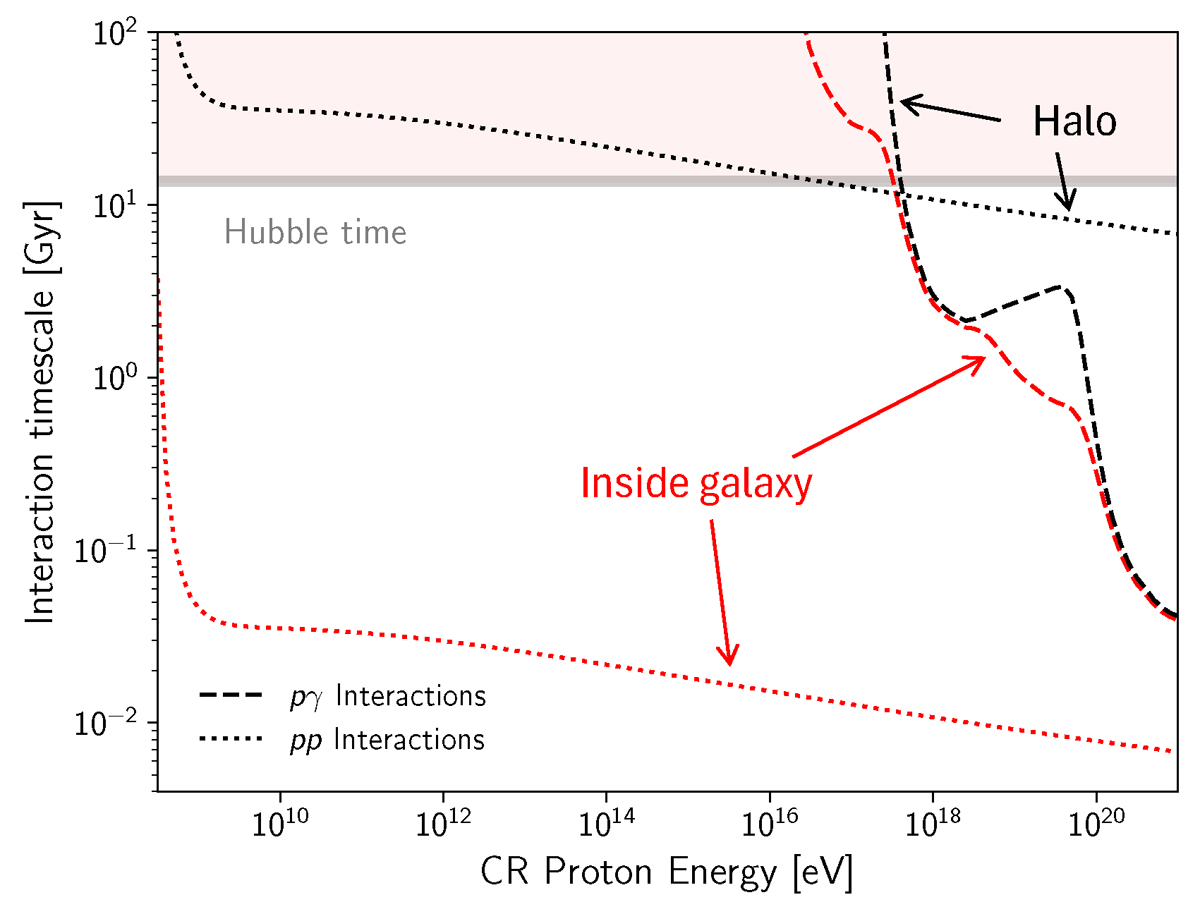
Characteristic timescales for a CR proton to undergo a hadronic interaction with ambient gas (pp interactions) or radiation (pγ interactions) shown for typical conditions in the galaxy interior (red lines) and halo (black lines). For the galaxy interior, we adopt a gas density of 1 cm−3 and stellar radiation fields consisting of a stellar component with T = 7100 K and an energy density of ∼0.7 eV cm−3, with a dust component at T = 60 K and an energy density of ∼0.3 eV cm−3. For halo conditions, we consider a reduced gas density of 10−3 cm−3, with radiation energy densities scaled down by a factor of 100. pγ losses with cosmological microwave background radiation at z = 0 are included for both galaxy interior and halo conditions, with photo-pair and photo-pion interactions occurring at the same rate in both environments. The Hubble timescale is shown in gray. Interaction timescales exceeding this (i.e., within the shaded pink region) practically do not occur. Hadronic pp and pγ interaction timescales are calculated following the approach of Owen et al. (2018), assuming that the invariant energy of an interaction is dominated by that supplied by the CR. For pp interactions, this uses the total inelastic cross-section parametrization of Kafexhiu et al. (2014). For pγ pion-production losses, the step-function approximation to the cross-section proposed by Dermer & Menon (2009) is adopted. Bethe-Heitler losses are treated using the simplified cross-section from the same reference, but with fitting parameters updated according to Owen et al. (2018), suitable for the energy range considered here.
Current usage metrics show cumulative count of Article Views (full-text article views including HTML views, PDF and ePub downloads, according to the available data) and Abstracts Views on Vision4Press platform.
Data correspond to usage on the plateform after 2015. The current usage metrics is available 48-96 hours after online publication and is updated daily on week days.
Initial download of the metrics may take a while.