


Fig. 13.
Download original image
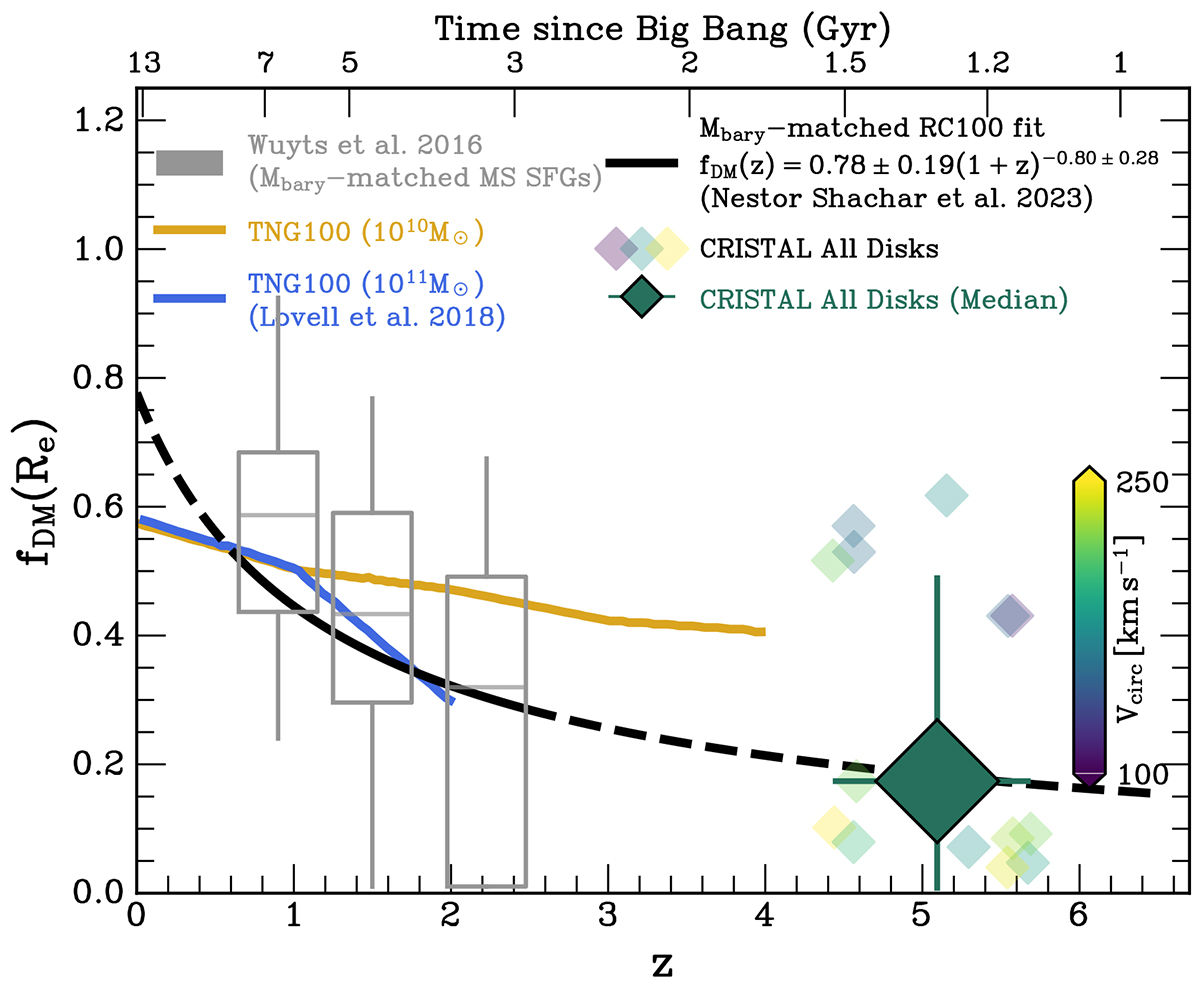
DM fraction at effective radius (fDM(Re)) as a function of redshift. The fDM(Re) of individual CRISTAL disks (4 < z < 6) are represented by small diamonds, colour-coded by their Vcirc(Re). For comparison, we include lower redshift studies around z = 2 from Wuyts et al. (2016) (grey box-and-whisker) and the best-fit relation to the RC100 data set (Nestor Shachar et al. 2023) (black solid line for the redshift range covered and dashed line for the extrapolated range). For both observational studies, we consider only SFGs on the MS and the baryonic mass Mbary matched within 0.3 dex of the CRISTAL disks. The new best-fit relation to RC100, using the Mbary-matched sample, is shown in the legend. The trends predicted from the TNG100 simulation for M* = 1010 M⊙ and M* = 1011 M⊙ are shown in yellow and blue, respectively (Lovell et al. 2018). Overall, the CRISTAL disks tend to be baryon-dominated on galactic scales, with a median DM fraction of ∼18% (large green diamond) that is tentatively consistent with the extrapolated relation based on RC100. However, there is a significant scatter in the values among the sample, partly driven by the scattered distributions of circular velocity Vcirc(Re) (and Σbary) shown in Figure 12.
Current usage metrics show cumulative count of Article Views (full-text article views including HTML views, PDF and ePub downloads, according to the available data) and Abstracts Views on Vision4Press platform.
Data correspond to usage on the plateform after 2015. The current usage metrics is available 48-96 hours after online publication and is updated daily on week days.
Initial download of the metrics may take a while.