


Fig. B.1.
Download original image
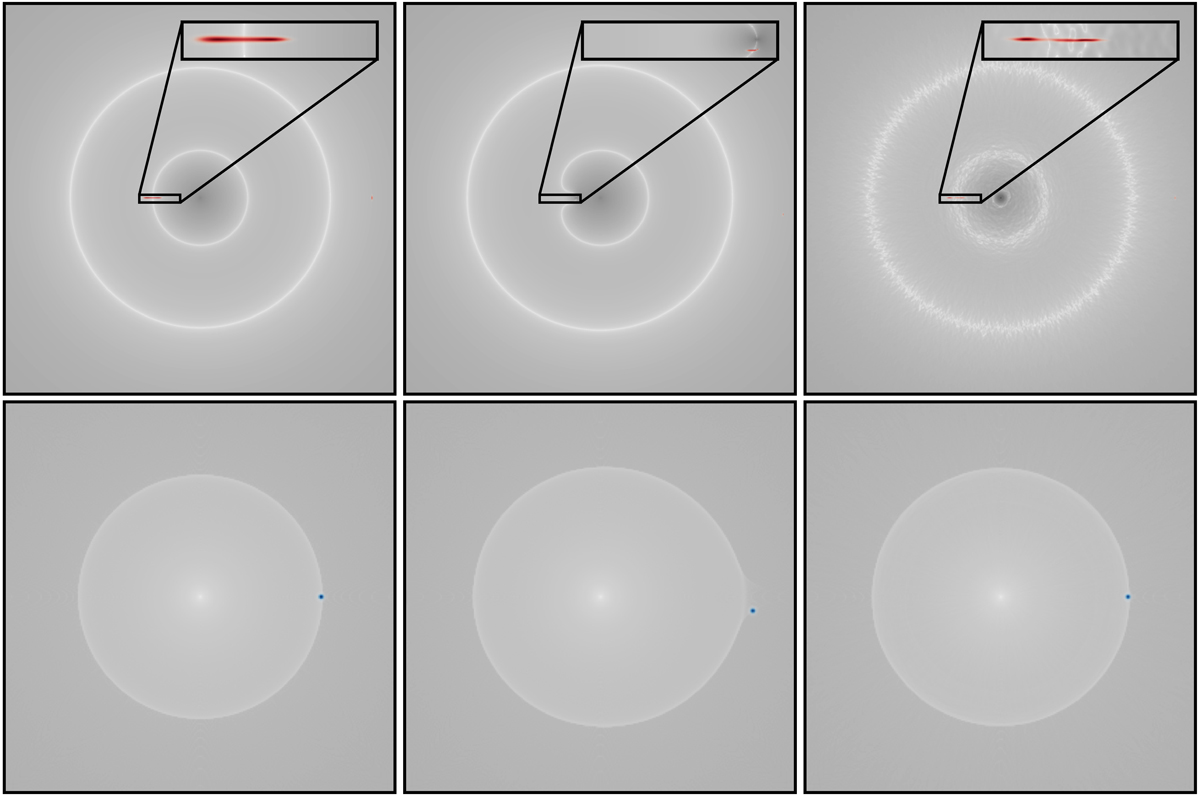
Radial image configurations for three lens models: a smooth particle-like CDM model (left panel), the same model with a 107 M⊙ subhalo placed halfway between the centre and the radial CC (central panel), and an FDM model corresponding to an axion mass of 5 × 10⁻²² eV (right panel). The top row shows the CCs, while the bottom row shows the corresponding caustics. The blue dots in the bottom panels represent a Gaussian source with a width of 0.8 pixels, placed at the radial caustic to produce bright radial images on the CC. The resulting arcs or images appear in red in the top panels. In the smooth CDM case, the arcs are symmetric and located on top of the radial CC. When a subhalo is added, a similar configuration arises, though the image appears closer to the centre and with lower magnification. In the FDM case, the arcs are asymmetric and exhibit magnification fluctuations on the scale of the axion’s de Broglie wavelength. The two merged radial images seen in the CDM case are now split into distinct components by the fluctuations. Although the caustics are broader in this case, we can confidently say that for an FDM lens, if the source size is comparable to the de Broglie scale, significant image position asymmetries and brighter images closer to the centre can arise compared to the particle-CDM model.
Current usage metrics show cumulative count of Article Views (full-text article views including HTML views, PDF and ePub downloads, according to the available data) and Abstracts Views on Vision4Press platform.
Data correspond to usage on the plateform after 2015. The current usage metrics is available 48-96 hours after online publication and is updated daily on week days.
Initial download of the metrics may take a while.