


Fig. 2.
Download original image
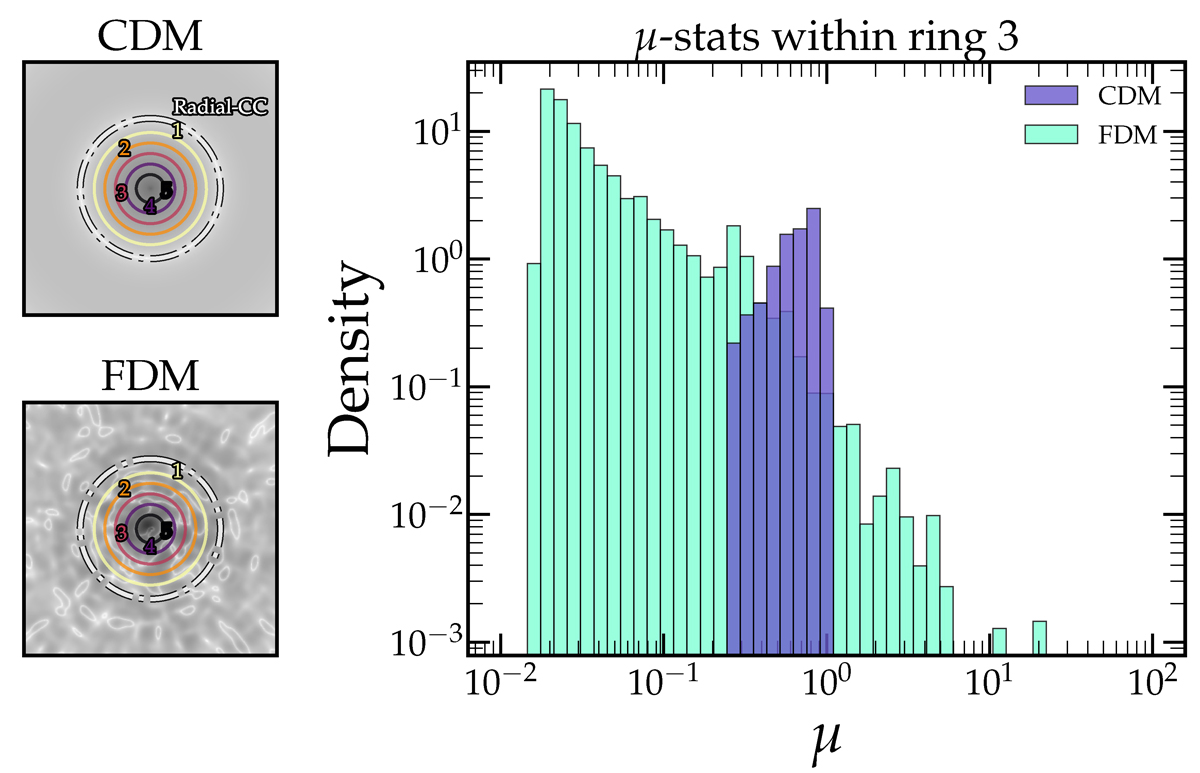
Illustration of the methodology employed in this work. Upper left: Zoom-in of the central halo region magnification map. The dot-dashed white line shows the position of the radial CC, where maximum magnification is achieved (alongside the tangential CC, not shown here). Bottom left: As in the upper left panel, but for the FDM case with a soliton structure at the centre, which further demagnifies the central region, along with wave-like mass density fluctuations that are both positive and negative. Negative fluctuations (δκ < 0) create islands of high magnification inside the CCs, whereas adding more mass (δκ > 0), both in FDM and in CDM, produces the opposite effect and increases demagnification. In both cases, the coloured rings show isomagnification contours (defined in the symmetric CDM case as the CC shape and scaled down by a factor r/rCC) inside the radial CC. These contours enclose regions where we collect magnification statistics of the simulated pixels within each curve for later comparison. Right: Example magnification statistics. Both histograms show the magnification of pixels within the third ring (dark pink) of the left panels. The purple histogram shows the CDM prediction, where μ ≲ 1, as expected for an NFW profile. Ligh blue bins represent the FDM prediction, where both the positive and negative fluctuations in δκ reduce and enhance the magnification compared to CDM. This results in a high probability of both demagnified and highly magnified images. These simulations correspond to a perfectly symmetrical lens (e = 0), a halo mass of M200 = Mh = 7 × 10¹¹ M⊙, and an axion mass of mψ = 10−22 eV.
Current usage metrics show cumulative count of Article Views (full-text article views including HTML views, PDF and ePub downloads, according to the available data) and Abstracts Views on Vision4Press platform.
Data correspond to usage on the plateform after 2015. The current usage metrics is available 48-96 hours after online publication and is updated daily on week days.
Initial download of the metrics may take a while.