


Fig. 1.
Download original image
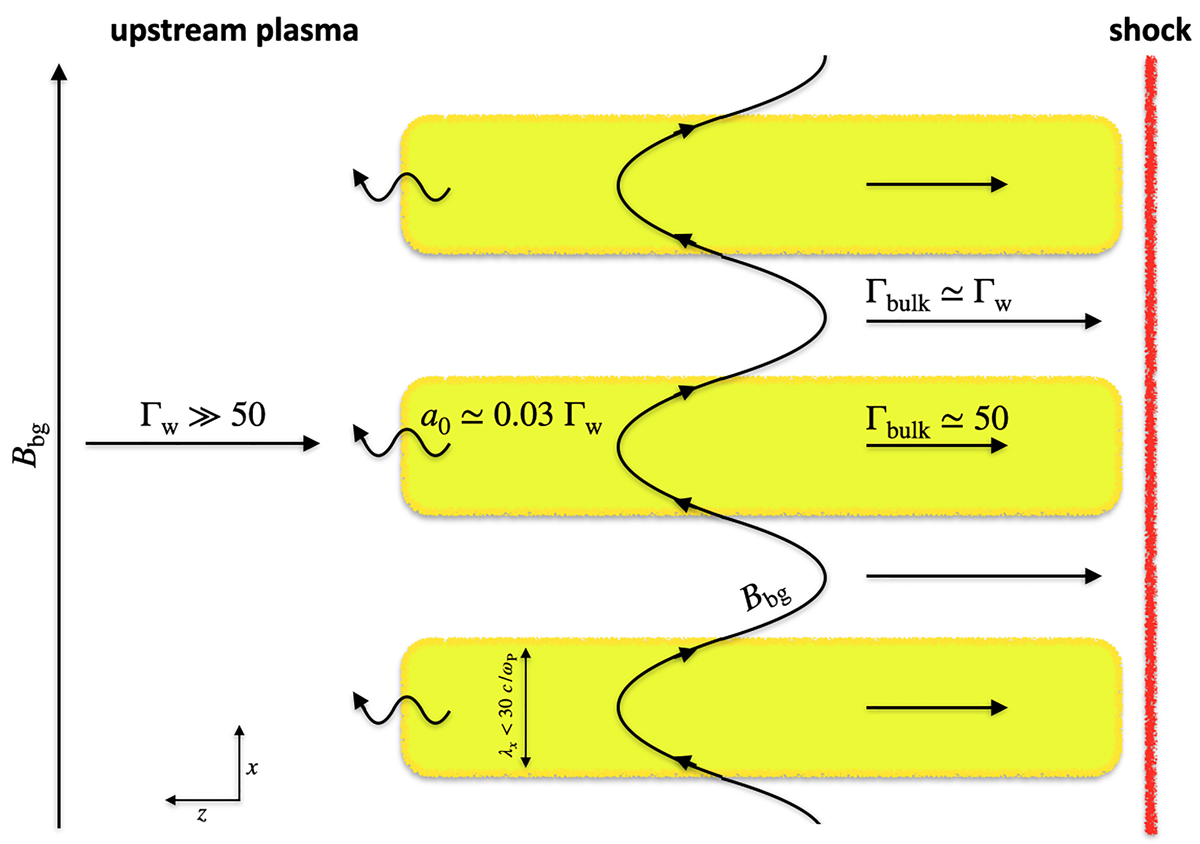
Structure of relativistic quasi-perpendicular electron-positron shocks. For simplicity, we consider a magnetization σ < 1 (the general case is discussed in the text). The upstream plasma is threaded by a uniform background magnetic field. In the shock frame, the plasma has a large Lorentz factor, Γw ≫ 50. The shock produces an electromagnetic precursor with large strength parameter, a0 ≃ 0.03 Γw. The filamentation instability breaks the precursor into radiation filaments (indicated with the yellow regions), whose transverse scale is of the order of a few plasma skin depths. Inside radiation filaments, the bulk Lorentz factor of the plasma decreases to Γbulk ≃ 50, whereas outside filaments one has Γbulk ≃ Γw. The relativistic shear flow distorts the background magnetic field lines and produces a magnetic field component parallel to the shock normal that reverses across each filament (see Eq. (48)). The longitudinal scale of individual radiation filaments can be shorter than the total length of the precursor. In this case, the precursor would be broken into several incoherent filaments along the z direction.
Current usage metrics show cumulative count of Article Views (full-text article views including HTML views, PDF and ePub downloads, according to the available data) and Abstracts Views on Vision4Press platform.
Data correspond to usage on the plateform after 2015. The current usage metrics is available 48-96 hours after online publication and is updated daily on week days.
Initial download of the metrics may take a while.