


Fig. 6
Download original image
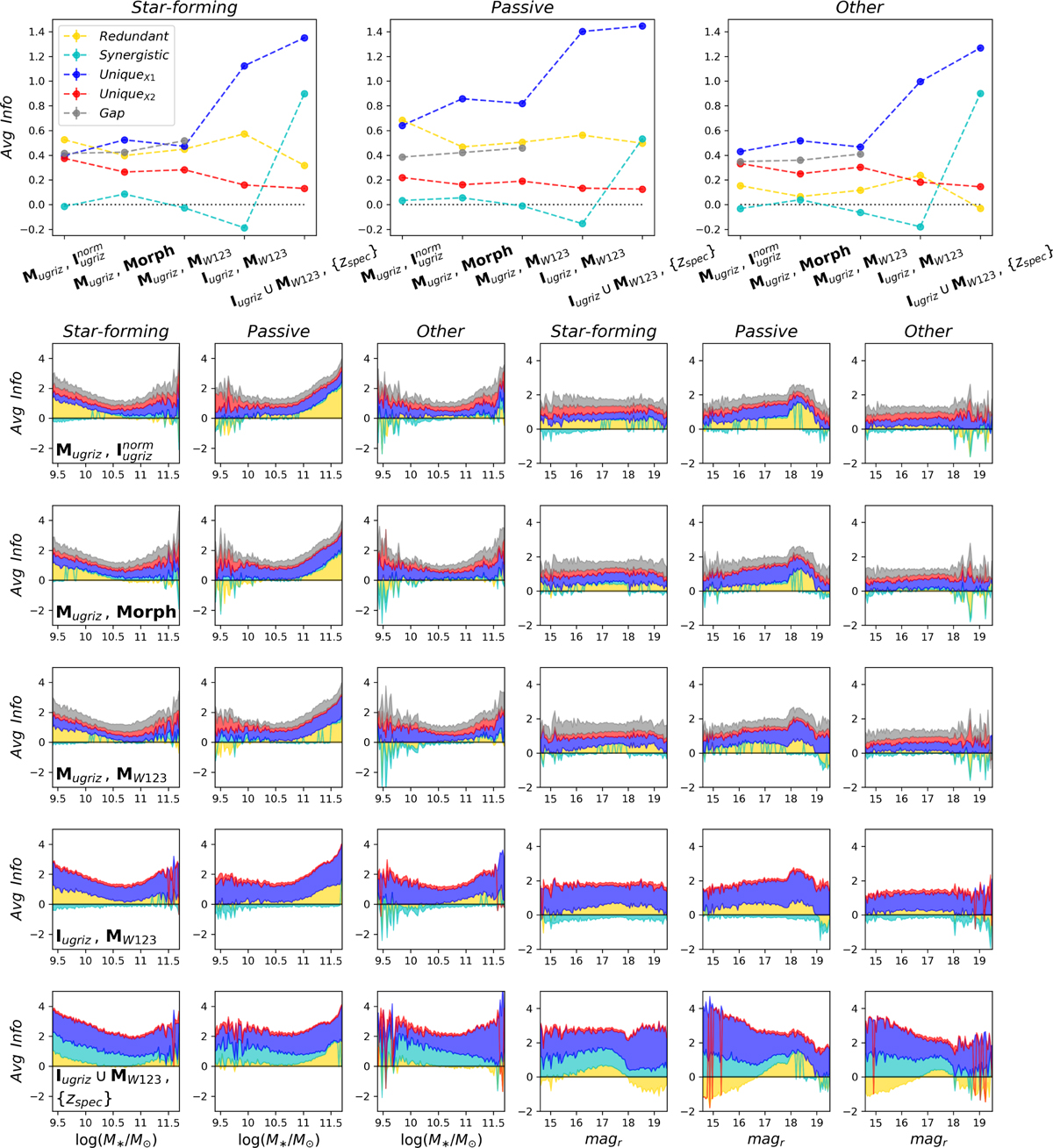
Mutual information decomposition for analyzing the contributions of different data modalities to the stellar mass estimation, involving photometry, morphology, images, and spec-ɀ (defined in Table 3). The redundant, unique, and synergistic components are all illustrated. In each tuple, the dataset labeled on the left is referred to as X1, and the one on the right is referred to as X2, distinguished for the unique information (shown in blue and red, respectively). First row: average information level of each component (in units of nats) for the five cases, separately shown for star-forming, passive, and other galaxies from the test sample. The information “gap” between each of the first three cases and Iu𝑔riz is also illustrated, indicating the loss of synergy when separating photometry and morphology (i.e.,  and <Mu𝑔riz, Morph>), or the outperformance of optical images over optical and infrared photometry combined (i.e., <Mu𝑔riz, MW123>). Furthermore, negative information is allowed as an indication of misinformation, which, particularly shown in the case <Iu𝑔riz, MW123 >, shrinks the incremental contribution of infrared photometry in the presence of optical images. The black dotted lines indicate zero mutual information. Remaining rows: stack plots of different information components (in units of nats) as a function of stellar mass or r-band magnitude for the five cases, separately shown for star-forming, passive, and other galaxies from the test sample. The shown windows exclude the tails of the stellar mass and r-band magnitude distributions since they are heavily affected by low sample statistics. The vertical extents of the stacked areas above and below zero indicate the total amounts of positive and negative information, respectively, in any stellar mass or r-band magnitude bin. The varying information levels in the stack plots reflect the effects of data imbalance.
Current usage metrics show cumulative count of Article Views (full-text article views including HTML views, PDF and ePub downloads, according to the available data) and Abstracts Views on Vision4Press platform.
Data correspond to usage on the plateform after 2015. The current usage metrics is available 48-96 hours after online publication and is updated daily on week days.
Initial download of the metrics may take a while.