


Fig. 5.
Download original image
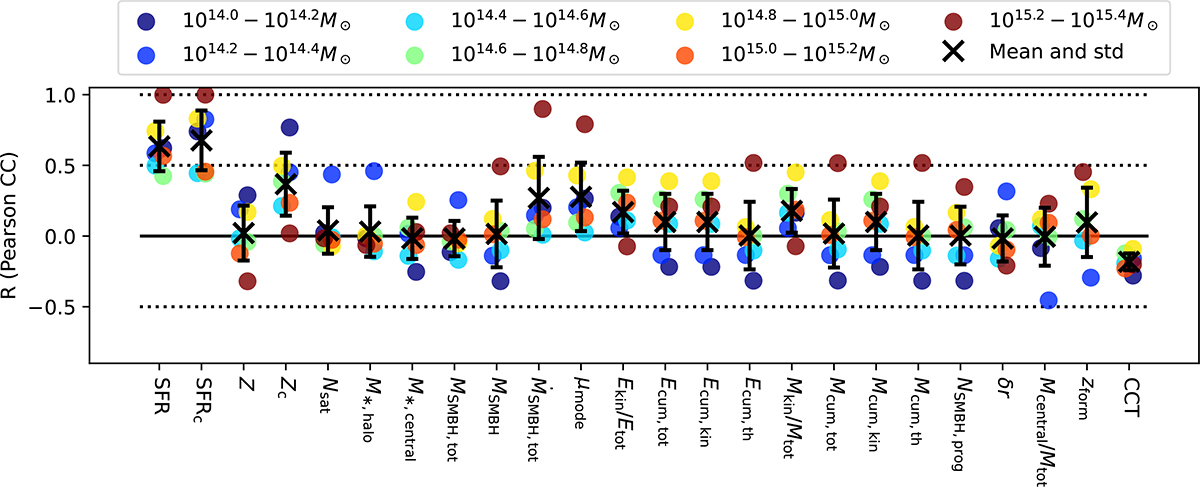
Same as Figure 4 but for the gas at the center of clusters. Namely, we show the Pearson correlation coefficients between cool gas fraction and halo and galaxy properties but here, instead of accounting for the cool gas within the entire 2R200c halo region, we consider it within the cluster core, R < 0.05R200c. This may include gas not bound in the BCG but satellite galaxies as well. The properties considered are described in Table 1. We split the sample into seven 0.2 dex mass bins (colored circles). The points have a small horizontal scatter for visual clarity. The black crosses mark the mean correlation coefficient over all mass bins, including error bars for standard deviation. The black dotted lines mark, from top to bottom, the position of R = 1, 0.5 and −0.5. Cool gas mass fraction within the central 5% of the virial radius correlates strongly with star-formation rate, measured both in the central galaxy and integrated over all galaxies of the cluster.
Current usage metrics show cumulative count of Article Views (full-text article views including HTML views, PDF and ePub downloads, according to the available data) and Abstracts Views on Vision4Press platform.
Data correspond to usage on the plateform after 2015. The current usage metrics is available 48-96 hours after online publication and is updated daily on week days.
Initial download of the metrics may take a while.