


Fig. 9
Download original image
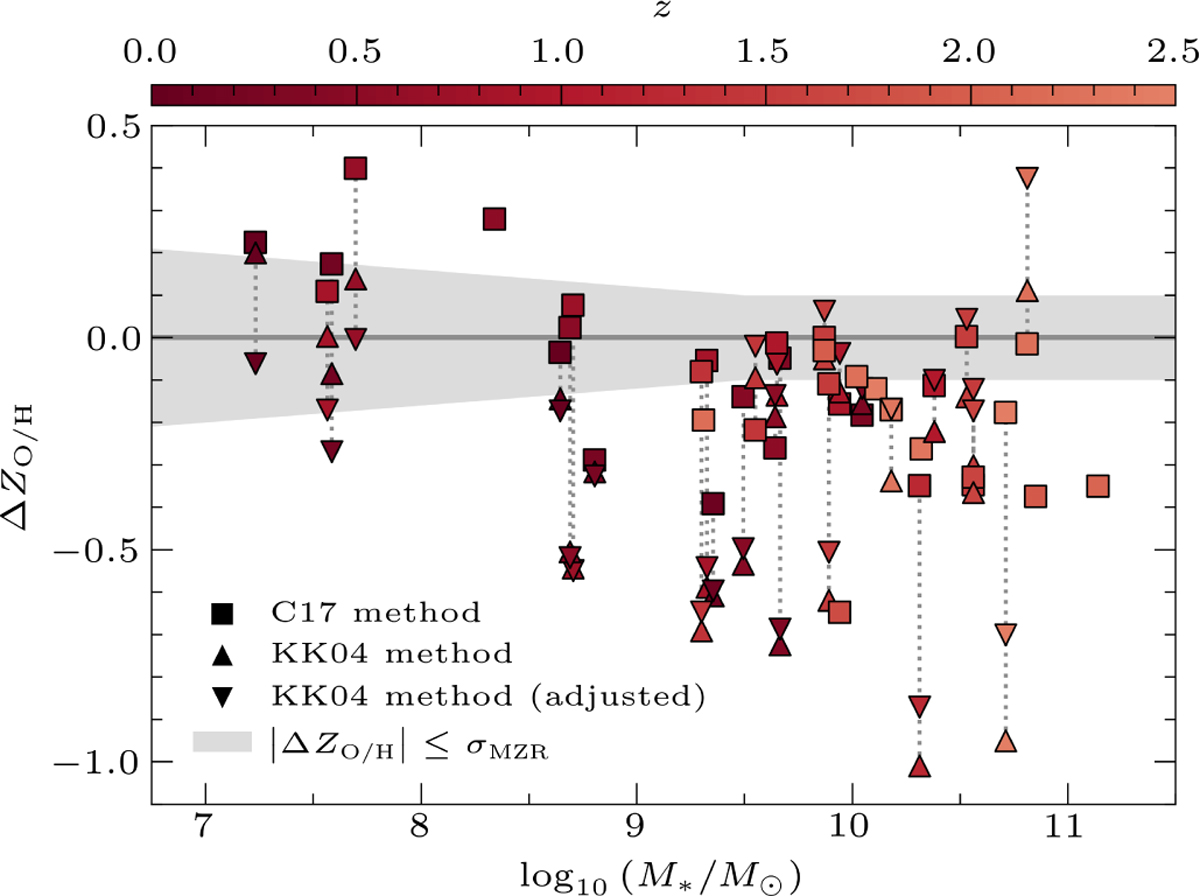
Difference (ΔZO/H) between observed metallicity and metallicity determined through the MZR (Eqs. (7)–(9), as well as Table 2) as a function of host galaxy stellar mass. In other words, if ΔZO/H > 0, the observed metallicity exceeds the value predicted by the MZR, and vice versa. The figure contains metallicity estimates from Graham et al. (2023), who use the Curti et al. (2017, 2020, “C17”) method, which are compared to the Sanders et al. (2021) MZR (squares), and the Kobulnicky & Kewley (2004, “KK04”) method, which are compared to the Kobulnicky & Kewley (2004) MZR as listed in Table 2 (triangles) as well as a version of this MZR with adjusted low-mass slope (inverted triangles), as defined by Chruślińska et al. (2021). The different estimates are connected by dotted lines for the same LGRBs. For some LGRBs there is no KK04 estimate. The stellar masses were taken from Svensson et al. (2010) and Perley et al. (2016c) and corrected to a Kroupa (2001) IMF. These LGRBs have redshifts z ≤ 2.5 (see colour bar at top). Moreover, the shaded region shows σMZR (Eq. (10)).
Current usage metrics show cumulative count of Article Views (full-text article views including HTML views, PDF and ePub downloads, according to the available data) and Abstracts Views on Vision4Press platform.
Data correspond to usage on the plateform after 2015. The current usage metrics is available 48-96 hours after online publication and is updated daily on week days.
Initial download of the metrics may take a while.