


Fig. 1.
Download original image
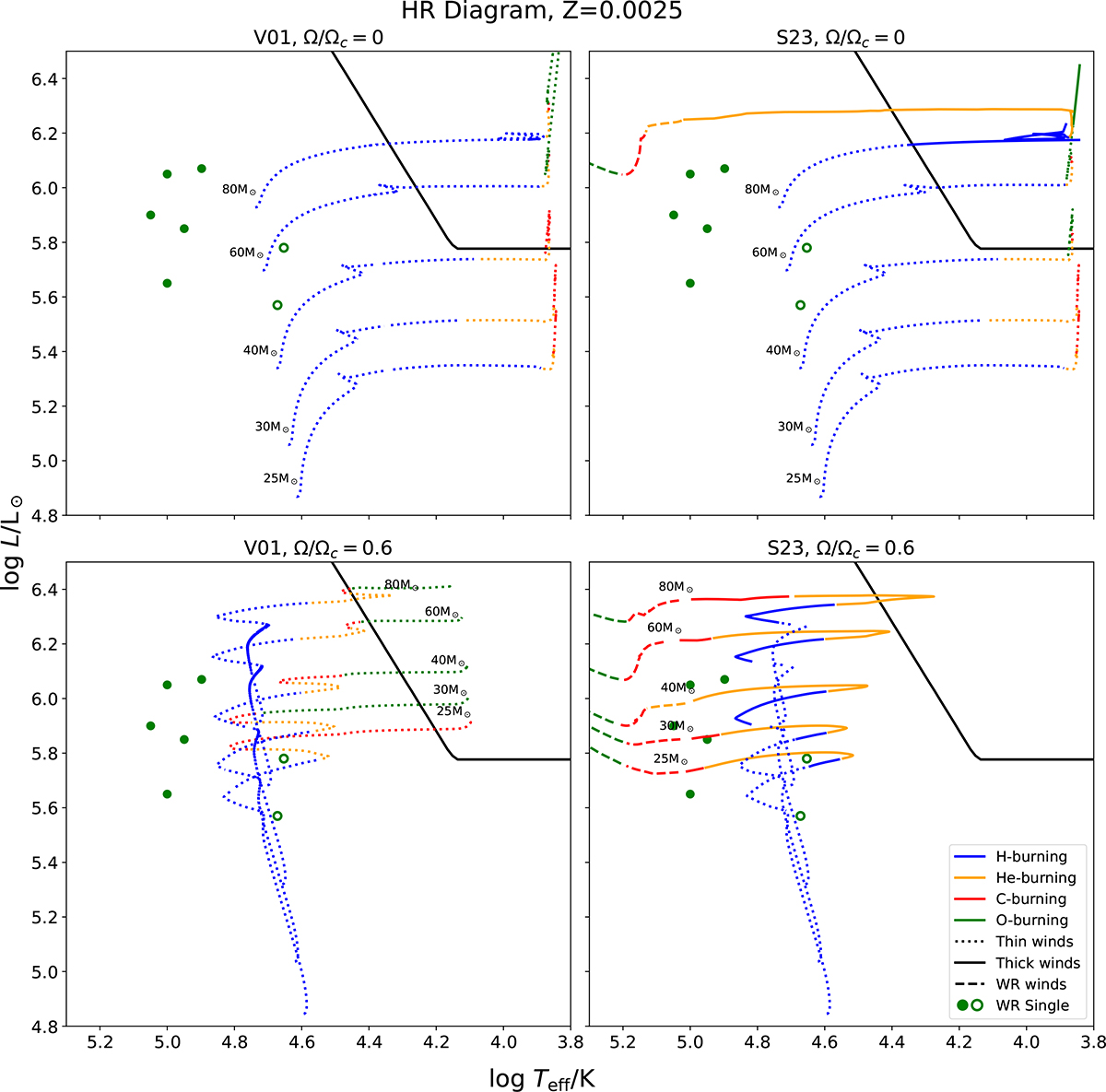
Stellar tracks on the HR diagram for initial masses M = 25, 30, 40, 60, and 80 M⊙ at metallicity Z = 0.0025. In the left-hand panels, the V01 model with only optically thin winds is implemented. In the right-hand panels, the S23 model is enforced, with the possibility to activate optically thick winds. The upper panels show the case with no rotation, while the lower panels the Ω/Ωc = 0.6 case. Different line styles represent different wind regimes: dotted for optically thin winds, solid for optically thick winds, dashed for WR-type winds. Colors represent different burning stages, defined as the element whose burning generates most of the energy of the star. Blue is for H-burning through CNO, orange for He-burning through triple α, red for carbon burning, and green for oxygen burning. Green circles are observations of single WRs (Hainich et al. 2015), filled for the hottest, open for the coldest. The lower-right plot shows that the combination of optically thick winds and high initial rotation is able to self-strip stars even at SMC metallicity. Stars in the lower-right plot (S23, Ω/Ωc = 0.6) avoid the HD limit and transition from main-sequence stars to WRs.
Current usage metrics show cumulative count of Article Views (full-text article views including HTML views, PDF and ePub downloads, according to the available data) and Abstracts Views on Vision4Press platform.
Data correspond to usage on the plateform after 2015. The current usage metrics is available 48-96 hours after online publication and is updated daily on week days.
Initial download of the metrics may take a while.