


Fig. 3.
Download original image
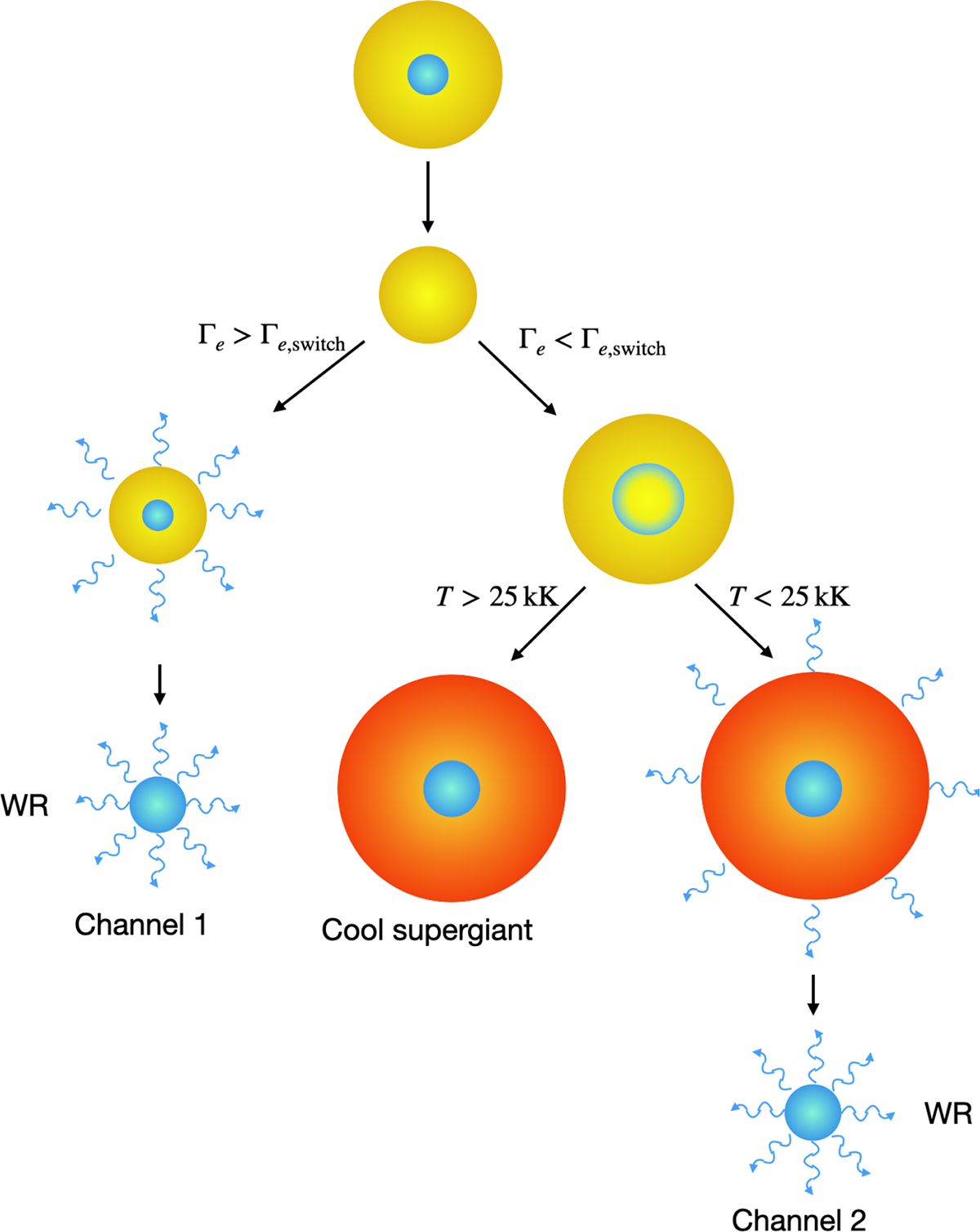
Illustration depicting the possible evolutionary paths of a chemically homogeneous star with initial mass ≳ 20 M⊙ at SMC metallicity. After core H-burning (yellow ball with blue center), the star contracts, Γe,switch decreases and Γe increases. If Γe > Γe,switch the star enters the optically thick winds regime (left arrow) and ends up being a WR (channel 1). If Γe < Γe,switch (right arrow), winds are still optically thin during shell H-burning (yellow ball with blue shell) and the star expands and cools, increasing Γe,switch. At this stage, there are two possible outcomes: (i) If the star cools enough to cross the bi-stability jump Teff < 25 kK (right arrow), it may enter the optically thick wind regime and become a WR (channel 2). (ii) If the star starts core He-burning at Teff > 25 kK (left arrow), Teff rises again, and the star does not cross the bi-stability jump. Optically thick winds are not activated (or are activated too late) and the star ends up being a cool supergiant.
Current usage metrics show cumulative count of Article Views (full-text article views including HTML views, PDF and ePub downloads, according to the available data) and Abstracts Views on Vision4Press platform.
Data correspond to usage on the plateform after 2015. The current usage metrics is available 48-96 hours after online publication and is updated daily on week days.
Initial download of the metrics may take a while.