


Fig. 4.
Download original image
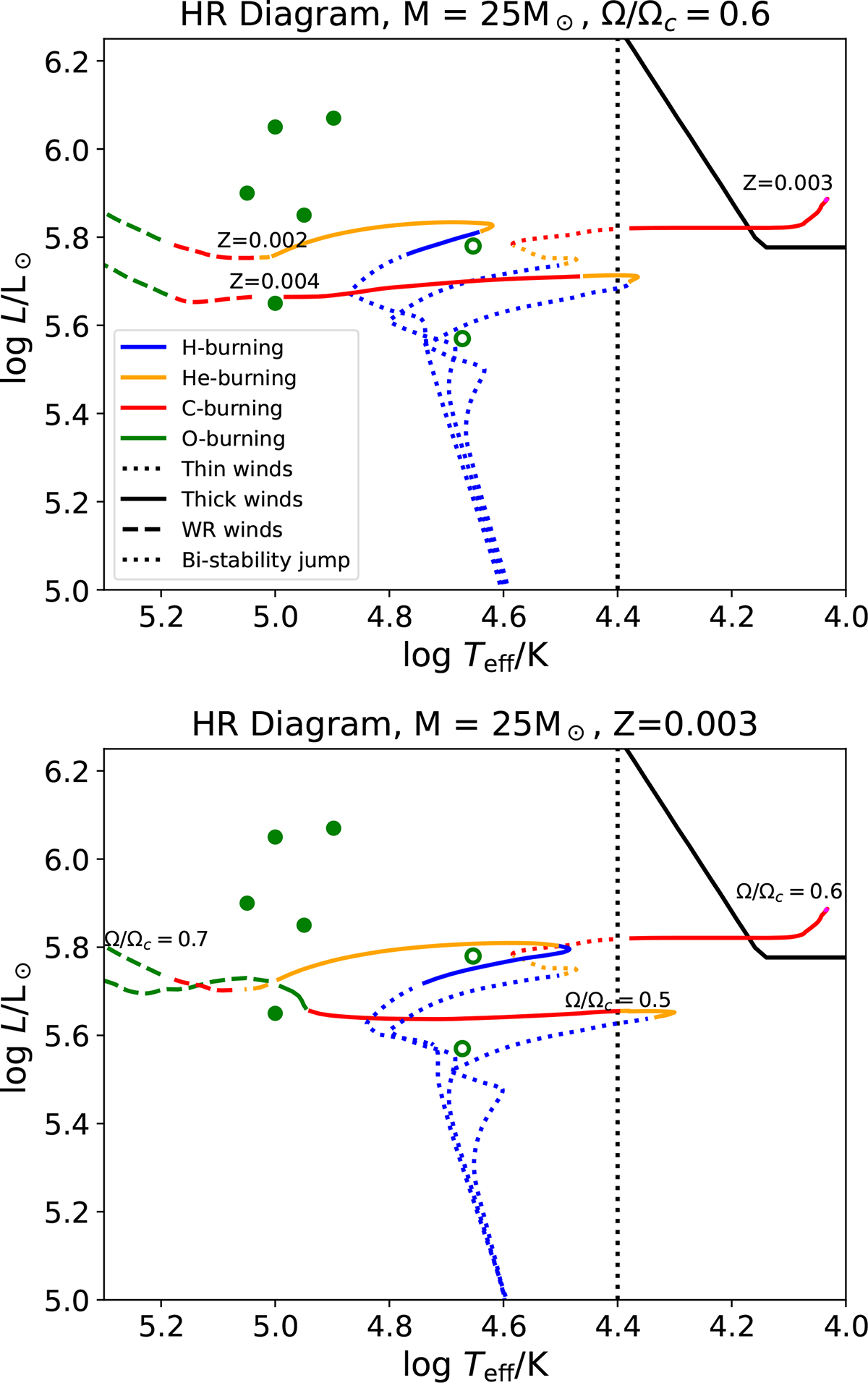
Stellar tracks for a 25 M⊙ star. The upper panel shows a rotating star with Ω/Ωc = 0.6 for three different metallicities Z = 0.002, 0.003, 0.004. The lower panel shows a star with metallicity Z = 0.003 for three different values of the initial rotation speed Ω/Ωc = 0.5, 0.6, 0.7. The linestyles and color code are the same as in Figure 1. The vertical dotted black line represents the temperature below which we expect the bi-stability jump. This Figure shows the non-monotonic dependence of mass-loss on metallicity and rotation. Low metallicity (Z = 0.002) favors the activation of optically thick winds through channel 1, because the star is more luminous and compact. Higher metallicity (Z = 0.004) can also activate optically thick winds through channel 2. Stars in the intermediate metallicity case (Z = 0.003), instead, fail to activate optically thick winds soon enough and end up as cool supergiant stars. The same trend happens for rotation.
Current usage metrics show cumulative count of Article Views (full-text article views including HTML views, PDF and ePub downloads, according to the available data) and Abstracts Views on Vision4Press platform.
Data correspond to usage on the plateform after 2015. The current usage metrics is available 48-96 hours after online publication and is updated daily on week days.
Initial download of the metrics may take a while.