


Fig. B.3
Download original image
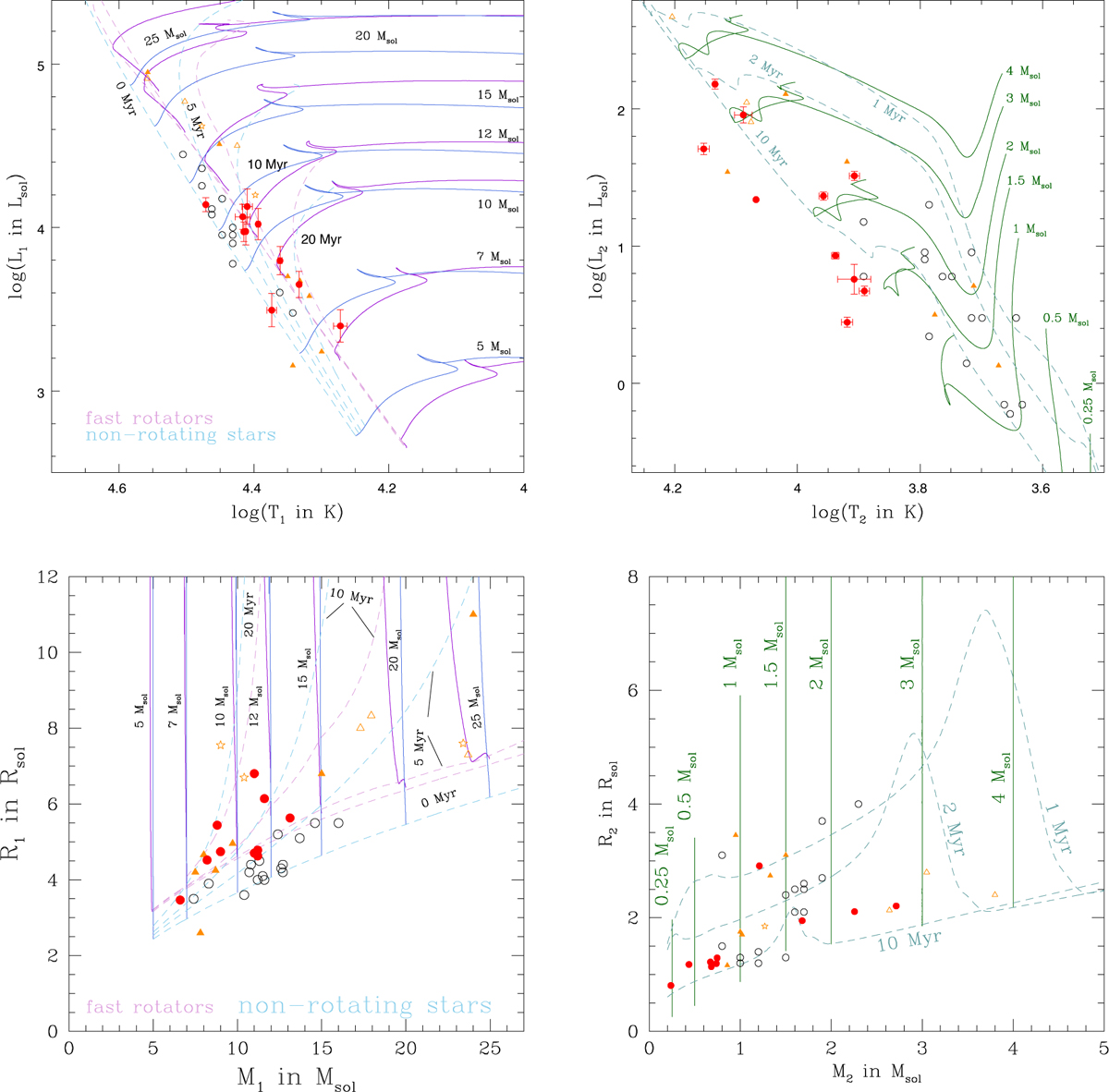
Hertzsprung-Russell diagrams for primaries (top left, with the post-PMS evolutionary tracks of Brott et al. (2011) without initial rotation in blue and with the fastest initial rotation available in these models in violet lines) and secondaries (top right, with the PMS tracks of Tognelli et al. 2011 in green). Isochrones are shown in lighter color and with dashed lines. Symbols as in Fig. 8. For our targets, the secondary effective temperatures are those without reflection and the bolometric luminosities were calculated from these temperatures and the stellar radii (Table A.3) while the bolometric luminosities of the primaries are those from Table A.1. Bottom panels provide the mass-radius diagrams, using the same conventions. The comparison with theoretical evolutionary tracks is not without limitations: we recall that the errors shown here are most probably underestimated (see Sect. 3.3) and that the tracks correspond to single stars, not to binary systems with strong reflection effects.
Current usage metrics show cumulative count of Article Views (full-text article views including HTML views, PDF and ePub downloads, according to the available data) and Abstracts Views on Vision4Press platform.
Data correspond to usage on the plateform after 2015. The current usage metrics is available 48-96 hours after online publication and is updated daily on week days.
Initial download of the metrics may take a while.