


Fig. 2.
Download original image
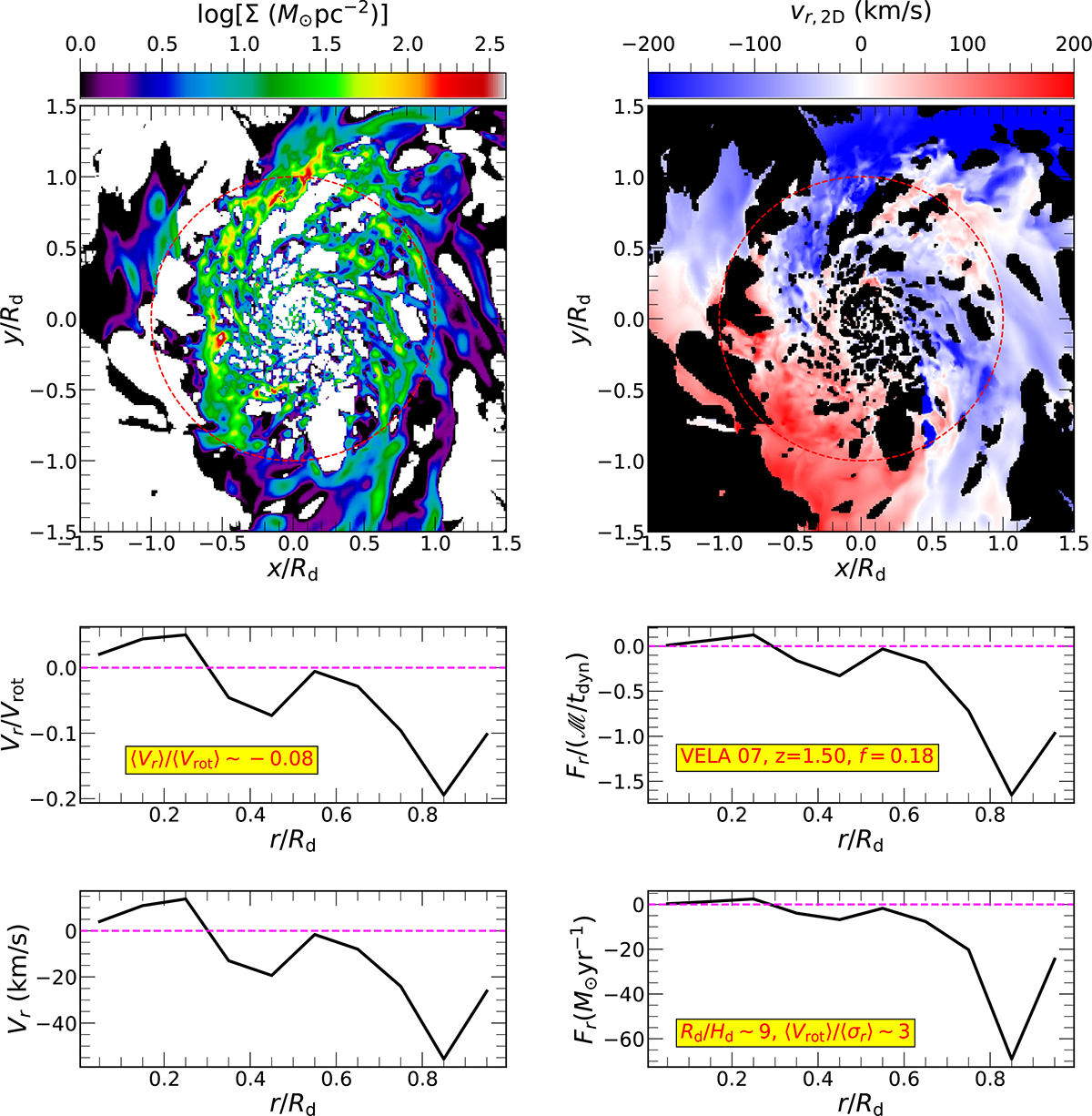
Radial transport in a VELA disk. For the simulated galaxy VELA 7 at a redshift of z = 1.5, the top-left and -right panels show face-on maps of the cold gas surface density (Σ) and the two-dimensional radial velocity (vr,2D), respectively, within a region spanning 3 Rd × 3 Rd, centered on the galactic center. The disk is large (Rd = 18.43 kpc) and thin (Rd/Hd ∼ 9). It is mainly supported by rotation, with ⟨Vrot⟩/⟨σr⟩∼3 and has a cold gas fraction of f = 0.18. Regions with no cold gas are shown as white in the surface density map and black in the radial velocity map. Dashed red circles mark the radial extent of the disk. Both maps exhibit strong non-axisymmetry, largely due to incoming cold gas streams. The middle left and right panels display the average radial velocity (Vr, in units of Vrot) and the radial mass flux (Fr, in units of ℳ/tdyn), respectively, as functions of r, normalized by Rd, out to the disk radius. Here, Vrot and ℳ are the average rotational velocity and mass of all cold gas at r, and tdyn = r/Vrot is the local dynamical time. The non-normalized Vr and Fr are shown in the bottom left and right panels, respectively. Beyond roughly 0.2 Rd, both Vr and Vrot are negative and tend to grow in magnitude with increasing r, albeit with some fluctuations, indicating a predominantly inflow-driven cold gas radial transport within the disk. The disk-averaged radial velocity is also negative and has a magnitude about 8% of the disk-averaged rotational velocity.
Current usage metrics show cumulative count of Article Views (full-text article views including HTML views, PDF and ePub downloads, according to the available data) and Abstracts Views on Vision4Press platform.
Data correspond to usage on the plateform after 2015. The current usage metrics is available 48-96 hours after online publication and is updated daily on week days.
Initial download of the metrics may take a while.