


Fig. 2.
Download original image
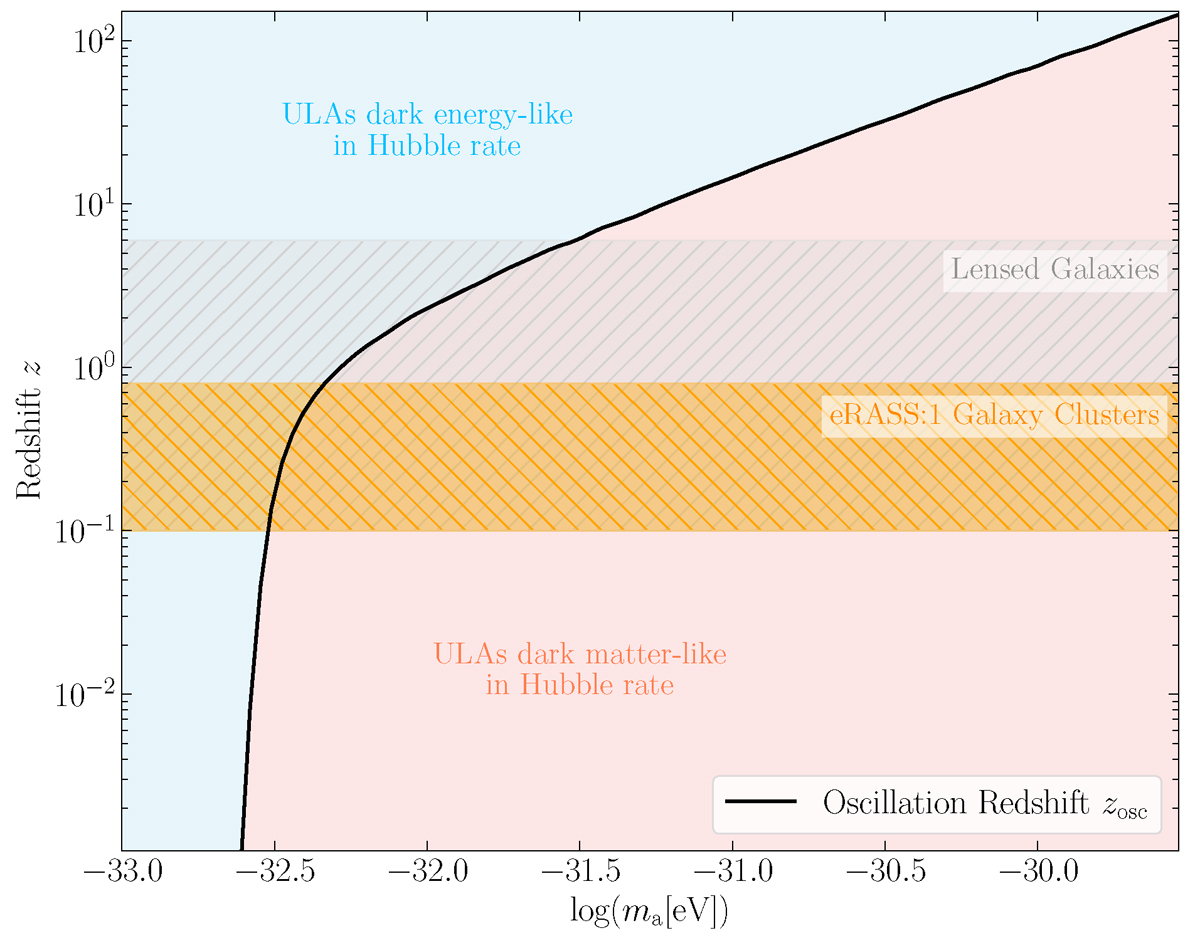
Demonstration of the ULA mass and redshift dependent regime change in the Hubble rate. In the pink regime, ULAs contribute to the Hubble rate e in a manner similar to dark matter; in the blue region, ULAs contribute to the Hubble rate in a dark energy-like fashion. The orange shaded region shows the eRASS1 cluster redshift range, while the gray shaded region shows the redshift range of lensed galaxies from the DES, HSC, and KiDS data, described in Sect. 3.2. Above a ULA mass of ma ∼ 10−31.5 eV, ULAs should be modeled as dark matter in the Hubble rate, resulting in correct distance measurements during the parameter inference. For ULAs with masses below ma ∼ 10−31.5 eV, the distance measurements are affected by the regime change via the Hubble rate, where ULAs are treated as dark energy.
Current usage metrics show cumulative count of Article Views (full-text article views including HTML views, PDF and ePub downloads, according to the available data) and Abstracts Views on Vision4Press platform.
Data correspond to usage on the plateform after 2015. The current usage metrics is available 48-96 hours after online publication and is updated daily on week days.
Initial download of the metrics may take a while.