


Fig. 10.
Download original image
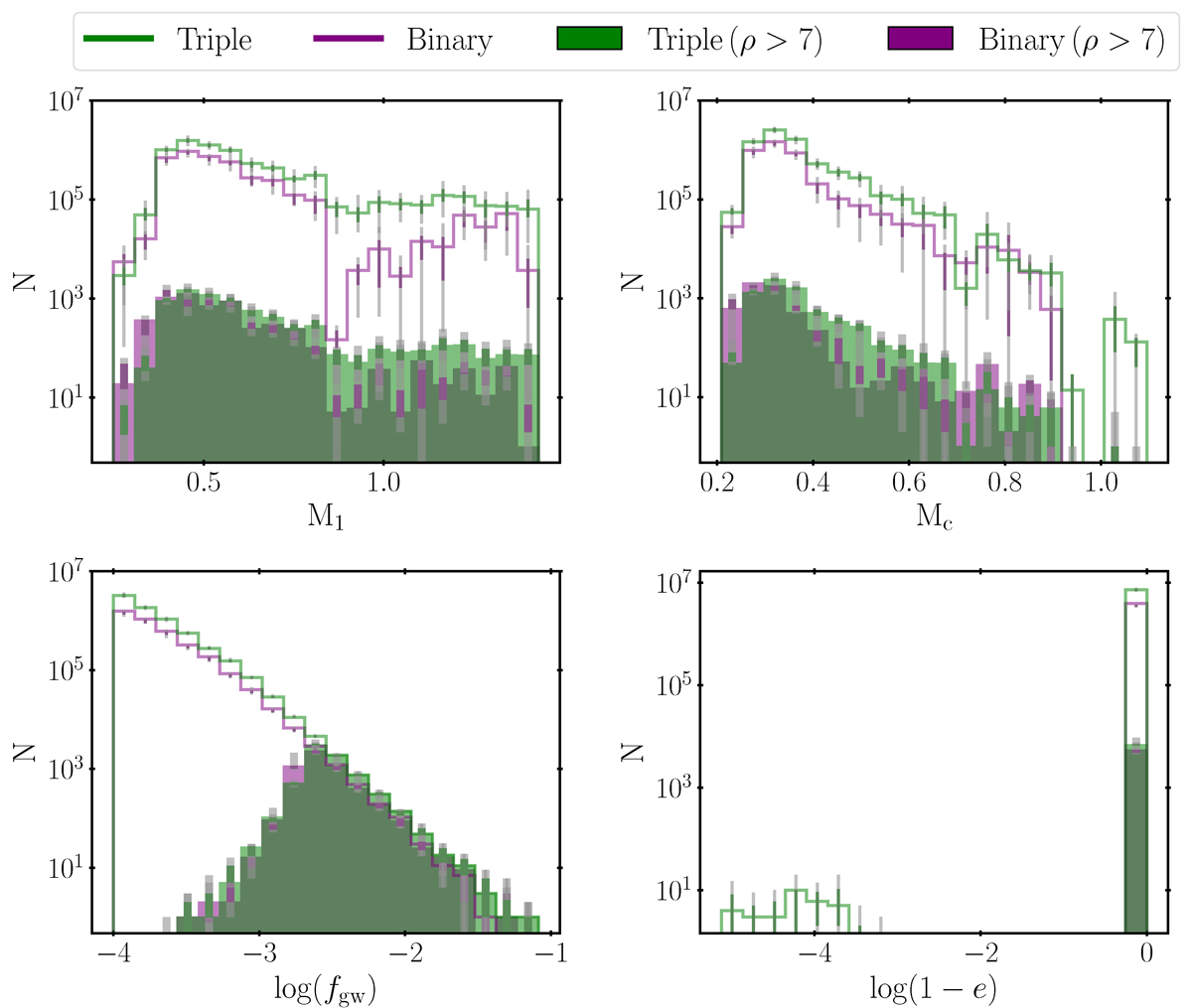
Population properties of LISA-detectable double white dwarfs from triple systems compared to isolated binaries. Triple-origin systems tend to produce more massive white dwarfs than isolated binaries. Outline (step) histograms represent the total LISA-detectable population, while filled histograms show the subset of systems individually resolvable with S/N > 7. For more on the distributions shown, refer to Sect. 4.2. Green indicates triple-origin systems, and purple indicates isolated binaries. Thin and thick vertical lines show the 68.3% confidence intervals for the full and individually resolvable populations, respectively. The vertical gray lines indicate the full range of values spanned in each bin. Confidence intervals are estimated via bootstrap resampling and reflect the sampling uncertainty arising from the stochastic seeding of the Galaxy (see Appendix B for details).
Current usage metrics show cumulative count of Article Views (full-text article views including HTML views, PDF and ePub downloads, according to the available data) and Abstracts Views on Vision4Press platform.
Data correspond to usage on the plateform after 2015. The current usage metrics is available 48-96 hours after online publication and is updated daily on week days.
Initial download of the metrics may take a while.