


Fig. 5.
Download original image
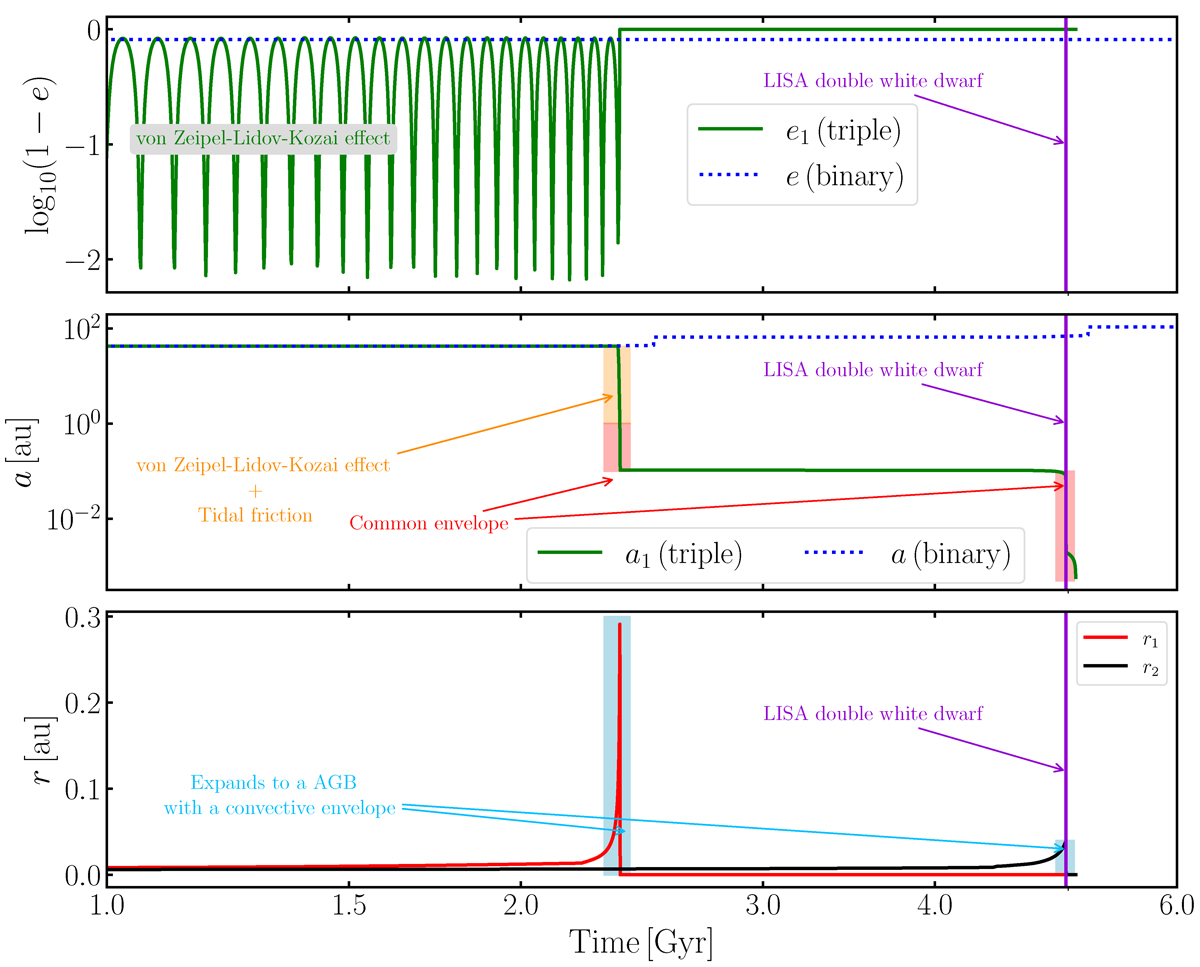
Comparative evolution of the properties of the inner binary of the triple with and without a third star. The three panels, from top to bottom, display the zoomed-in evolution of key parameters of the two stars: eccentricity, semi-major axis, and radius. In the case of the triple system, the inner binary experiences unstable mass transfer, causing it to shrink further and eventually enter the LISA band. Meanwhile, the inner binary when evolved without a tertiary star undergoes mass loss due to winds, resulting in an increase in its semi-major axis and a widening of the orbit. Here a1 (triple) and e1 (triple) represent the semi-major axis and eccentricity of the inner binary evolved with a tertiary star, while a (binary) and e (binary) show the semi-major axis and eccentricity of the same inner binary evolved without the tertiary star. Additionally, r1 and r2 represent the radii of the primary and secondary stars in the inner binary, respectively.
Current usage metrics show cumulative count of Article Views (full-text article views including HTML views, PDF and ePub downloads, according to the available data) and Abstracts Views on Vision4Press platform.
Data correspond to usage on the plateform after 2015. The current usage metrics is available 48-96 hours after online publication and is updated daily on week days.
Initial download of the metrics may take a while.