


Fig. 11.
Download original image
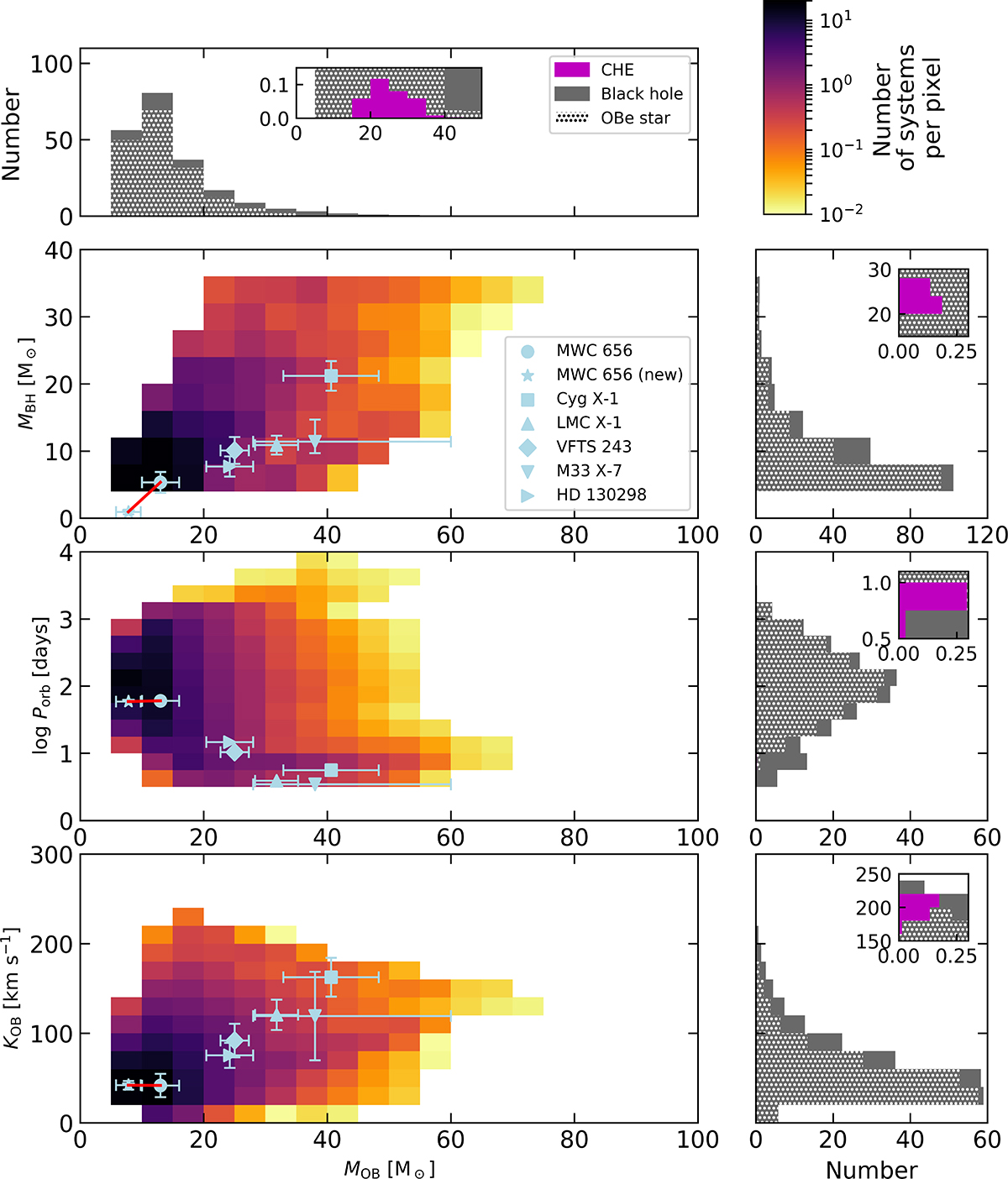
Properties of the ∼211 OB+BH binaries in our fiducial synthetic SMC population (cf. Table 3), as function of the mass of the OB star. The three main plots show the 2D number density distributions of the systems, with the OB star mass on the X axis, and BH mass, orbital period, and OB star orbital velocity semi-amplitude on the Y axis, respectively. The number density is colour coded (see colour bar on the top right). The known OB+BH binaries, irrespective of their host galaxy metallicity, are marked by blue symbols, and correspond to MWC 656 (Casares et al. 2014), Cyg X-1 (Miller-Jones et al. 2021), LMC X-1 (Orosz et al. 2009), M33 X-7 (Ramachandran et al. 2022), VFTS 243 (Shenar et al. 2022a), and HD 130298 (Mahy et al. 2022). The BH nature of the secondary star in MWC 656 debated in the literature. The solution by Janssens et al. (2023) is labelled by ‘MWC 656 (new)’ and connected to the solution by Casares et al. (2014) through a red line. The four histograms give the corresponding 1D projections, with shading identifying rapidly rotating OB stars (labelled ‘OBe’), and insets magnifying the small contributions from chemically homogeneous evolution (CHE). The orbital velocity semi-amplitudes for observed systems are calculated using Eq. (11) with the observed masses and orbital periods. The errors are calculated by error propagation.
Current usage metrics show cumulative count of Article Views (full-text article views including HTML views, PDF and ePub downloads, according to the available data) and Abstracts Views on Vision4Press platform.
Data correspond to usage on the plateform after 2015. The current usage metrics is available 48-96 hours after online publication and is updated daily on week days.
Initial download of the metrics may take a while.