


Fig. 8.
Download original image
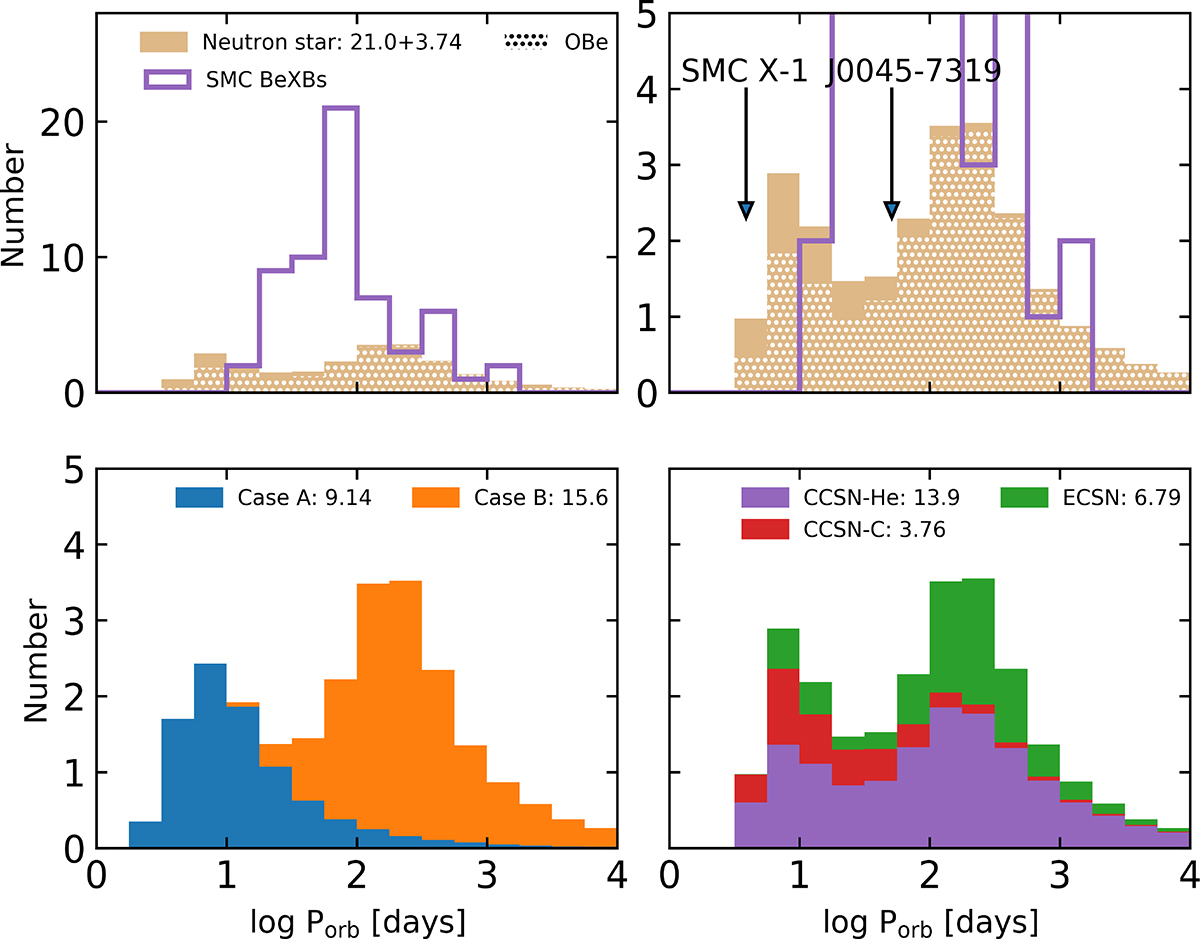
Distributions of the orbital periods of the ∼25 OB+NS binaries in our fiducial synthetic SMC population. Upper left: Predicted period distribution (yellow histogram), where the ∼21 OB+NS binaries in which the OB stars rotates faster than 95% of their critical rotational velocity are indicated by shading (labelled ‘OBe’). The period distribution of observed BeXBs in the SMC (Haberl & Sturm 2016) is plotted as purple line. Upper right: A zoom-in of the upper left panel. The B star + radio pulsar binary J0045-7319 (Bell et al. 1995) and the supergiant X-ray binary SMC X-1 (Rawls et al. 2011; Falanga et al. 2015) are indicated by arrows. Lower left: The same predicted distribution as in the top panels, with the colours indicating which of the systems formed through Case A and Case B mass transfer (blue and orange, respectively), with the corresponding total numbers given in the legend. Lower right: The same predicted distribution as in the top panels, with the colours indicating which type of SN, and therefore which NS kick distribution, was assumed for the different systems [green for electron-capture SN; red for helium-envelope-stripped SN (CCSN-C); purple for hydrogen-envelope-stripped SN (CCSN-He); cf. Sect. 2.6]. The predicted total numbers related to different SN types are given in the legend.
Current usage metrics show cumulative count of Article Views (full-text article views including HTML views, PDF and ePub downloads, according to the available data) and Abstracts Views on Vision4Press platform.
Data correspond to usage on the plateform after 2015. The current usage metrics is available 48-96 hours after online publication and is updated daily on week days.
Initial download of the metrics may take a while.