


Fig. 2.
Download original image
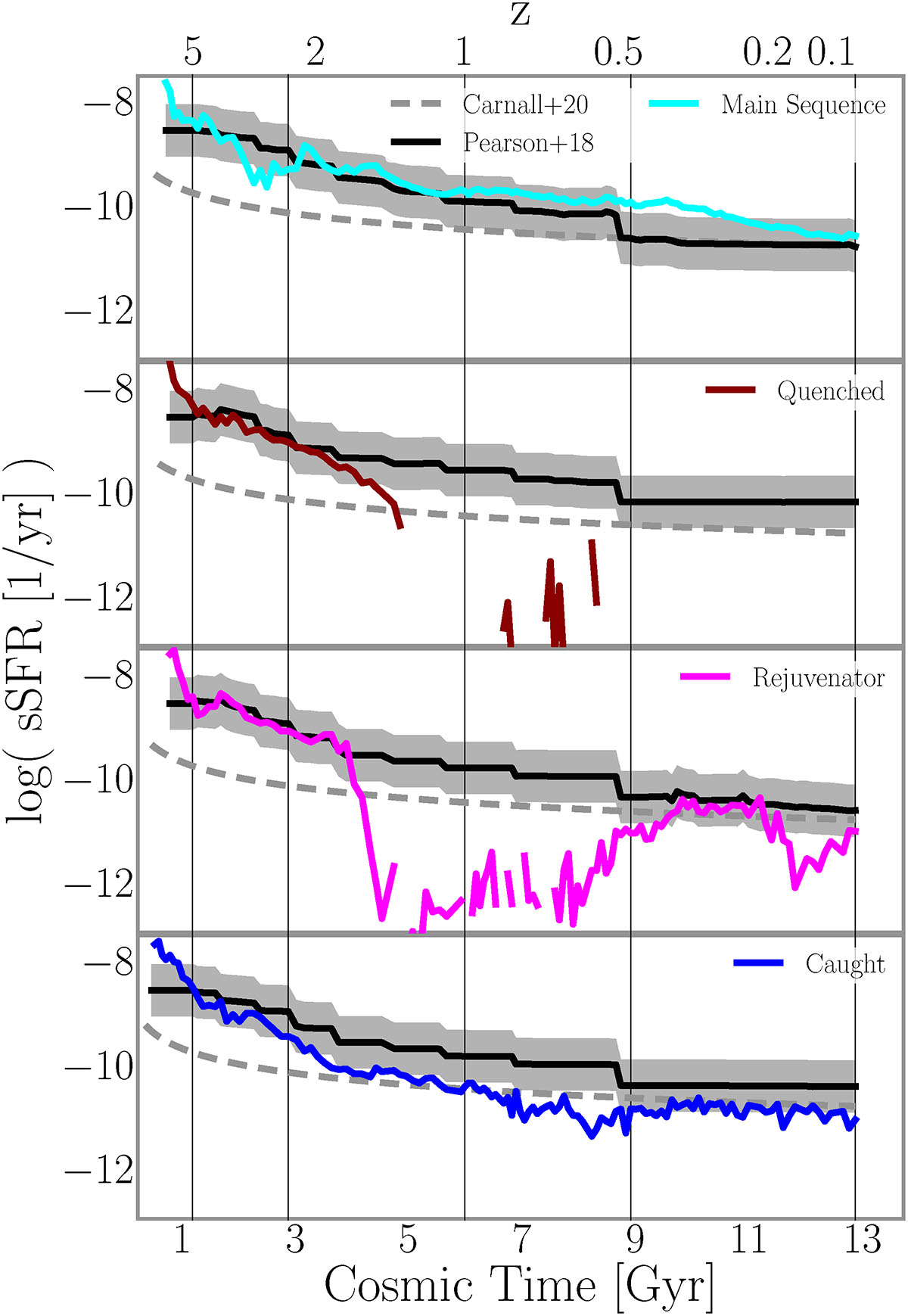
Examples of the four formation scenarios for galaxies with respect to sSFR changes over time. The black lines and shades indicate the main sequence values depending on the redshift and stellar mass of a galaxy according to results by Pearson et al. (2018) with a scatter of ±0.5 dex applied to differentiate between on or off the main sequence. From top to bottom, the panels show a main-sequence-type galaxy (cyan), an early-quenched galaxy (dark red), a rejuvenating galaxy (magenta), and a caught galaxy (blue). Two classes are not explicitly represented here. First, the “late-quenched” types only differ from the “early-quenched” by dropping off the main sequence after redshift z = 1. Second, rejuvenator-main-sequence-type galaxies recover a stable position on the main sequence at redshift z = 0, unlike rejuvenator-quenched-type galaxies, which also go through rejuvenation cycles but do not end up on the main sequence. The vertical lines highlight the snapshots corresponding to each row in Figure 3.
Current usage metrics show cumulative count of Article Views (full-text article views including HTML views, PDF and ePub downloads, according to the available data) and Abstracts Views on Vision4Press platform.
Data correspond to usage on the plateform after 2015. The current usage metrics is available 48-96 hours after online publication and is updated daily on week days.
Initial download of the metrics may take a while.