


Fig. 4.
Download original image
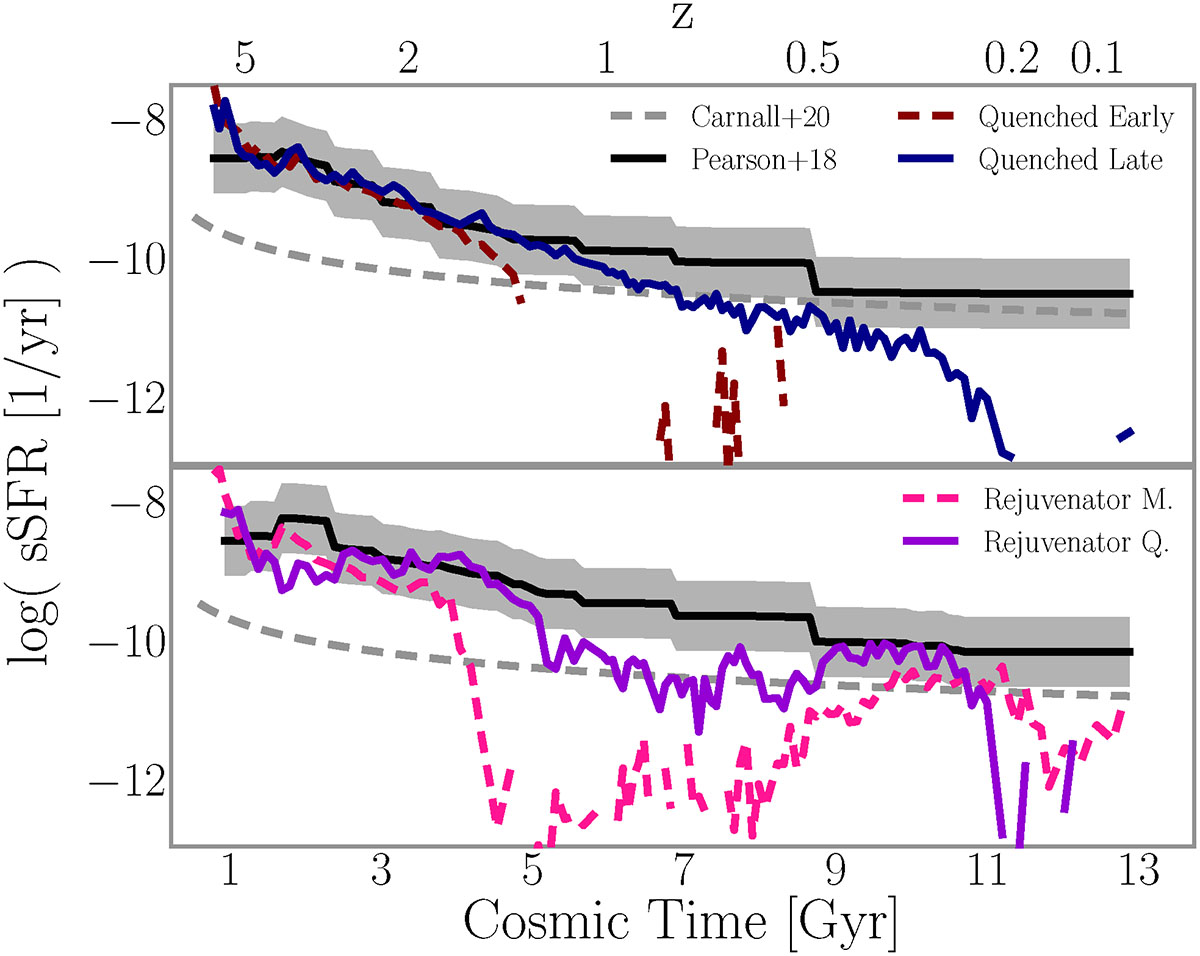
Similar to Figure 2 but focused on the difference between the subclass pairs of early- and late-quenched galaxies as well as quenched and main-sequence rejuvenators. The colored dashed lines represent the cases also shown in Figure 2, while the colored solid lines are the subtypes to differentiate. The gray dashed quiescence criteria (Carnall et al. 2020) and black-shaded SFMS expectations (Pearson et al. 2018) are derived from the stellar masses of the latter. This causes the pink dashed main-sequence-rejuvenator to not lie on the SFMS at z ≈ 0 due to the larger stellar mass (see Figure 5) and therefore lower sSFR. The early-quenched galaxy does recover star formation after quenching but never consistently makes it back onto the main sequence. The late-quenched galaxy also almost makes a passive rejuvenation akin to caught-type galaxies, since the main sequence drops at z < 0.5. However, it is still mostly more than 0.5 dex below the main sequence averaged over a smoothing window of one gigayear, ruling out a rejuvenation scenario. The main-sequence rejuvenator undergoes a more pronounced quenched phase than the quenched rejuvenator.
Current usage metrics show cumulative count of Article Views (full-text article views including HTML views, PDF and ePub downloads, according to the available data) and Abstracts Views on Vision4Press platform.
Data correspond to usage on the plateform after 2015. The current usage metrics is available 48-96 hours after online publication and is updated daily on week days.
Initial download of the metrics may take a while.