


Fig. 9.
Download original image
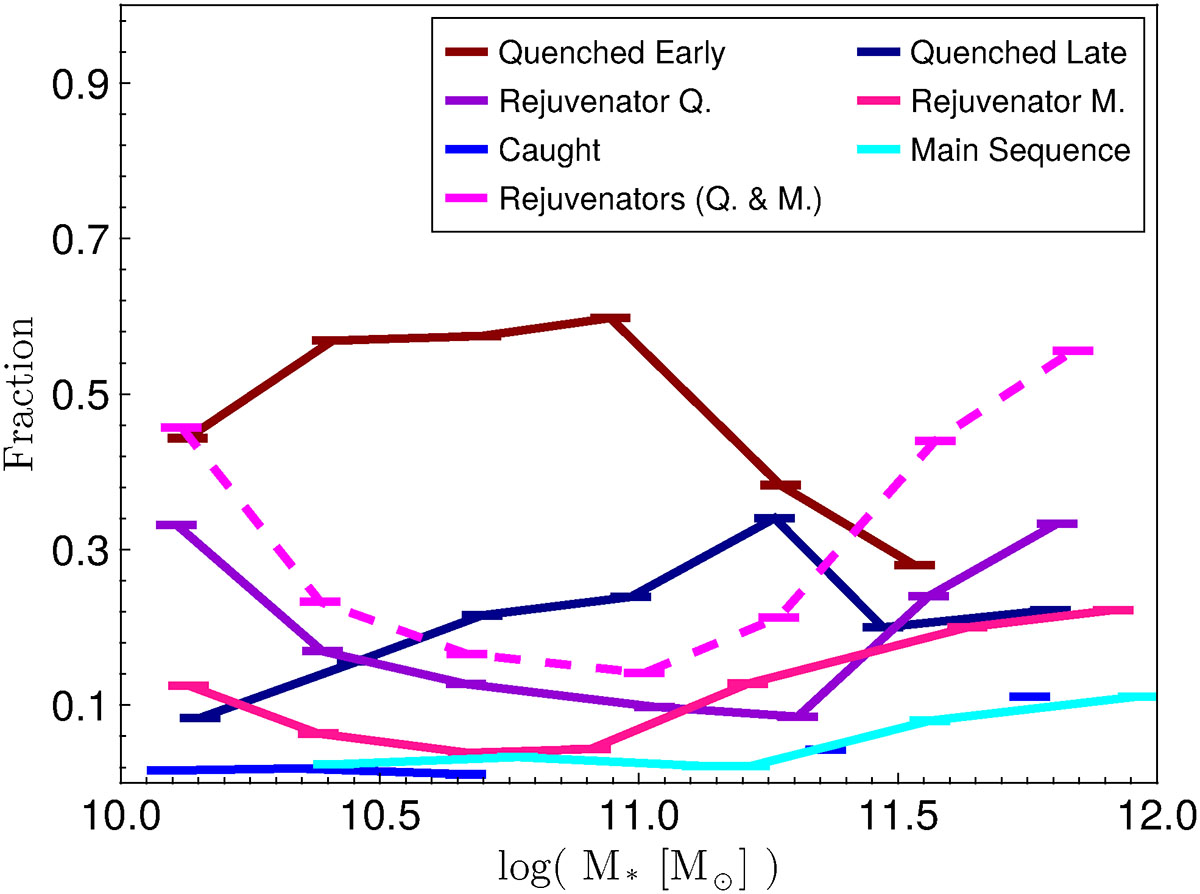
Fractions of formation class members in stellar mass bins at z ≈ 0. Slight shifts of data points originate from taking the median stellar masses instead of bin centers. Early-quenched galaxies (dark red) peak at around M* = 1011, while late-quenched ones (dark blue) peak at slightly higher masses. Galaxies with rejuvenation cycles (dashed magenta line) in their formation histories are more prevalent on the lower- and higher-mass ends of the range between 1010 M⊙ ≤ M* ≤ 1012 M⊙. Quenched rejuvenators (lilac) tend more toward lower masses, while a rejuvenation sustained until z ≈ 0 (pink) is more often found at higher masses. Main-sequence (cyan) and caught types (blue) are generally rare with a faint preference for the high-mass end. Both subtypes are more prevalent on the lower- and higher- mass ends of the range between 1010 M⊙ ≤ M* ≤ 1012 M⊙.
Current usage metrics show cumulative count of Article Views (full-text article views including HTML views, PDF and ePub downloads, according to the available data) and Abstracts Views on Vision4Press platform.
Data correspond to usage on the plateform after 2015. The current usage metrics is available 48-96 hours after online publication and is updated daily on week days.
Initial download of the metrics may take a while.