


Fig. 4.
Download original image
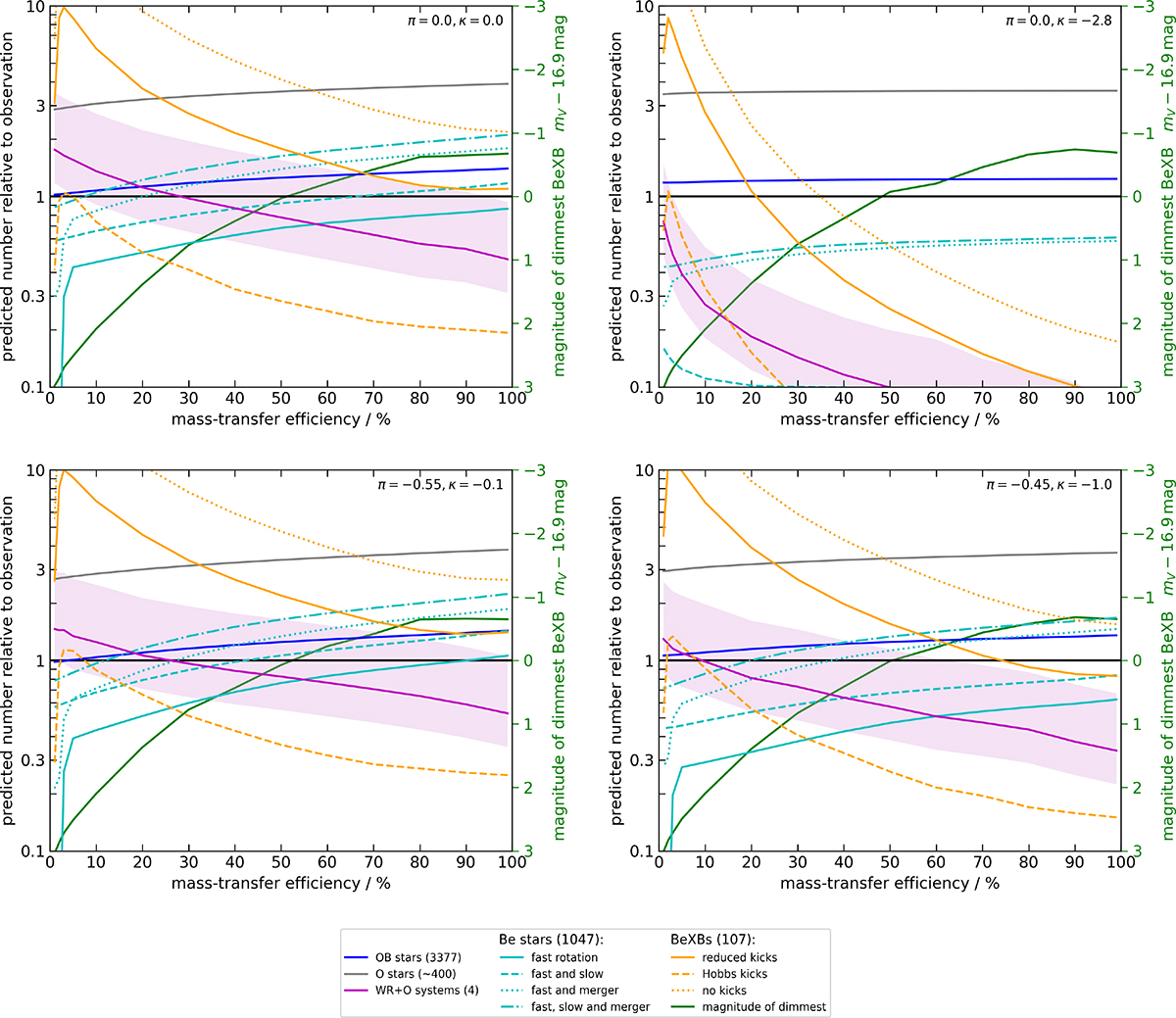
Predicted number of selected types of stars and binary systems relative to the observed number (given in parentheses in the legend) as a function of mass-transfer efficiency. We show four different assumptions about the stars that become OBe stars – fast rotating accretors (solid line), fast and slow rotating accretors (dashed), fast rotating accretors and merger products (dotted), fast and slow rotating accretors and merger products (dash-dotted) – and three different assumptions about the SN kick – reduced kicks (solid), Hobbs kicks (dashed), and no kicks (dotted). The green line with labelling on the right side of the diagram shows the magnitude of the dimmest synthetic BeXB relative to the dimmest observed one (16.9). The pink shading indicated the uncertainty due to the low number of WR + O systems. The initial binary parameter distributions are flat (top left), according to Sana et al. (2012, bottom left), Sana et al. (2013, bottom right), and Dunstall et al. (2015, top right).
Current usage metrics show cumulative count of Article Views (full-text article views including HTML views, PDF and ePub downloads, according to the available data) and Abstracts Views on Vision4Press platform.
Data correspond to usage on the plateform after 2015. The current usage metrics is available 48-96 hours after online publication and is updated daily on week days.
Initial download of the metrics may take a while.