


Fig. 2.
Download original image
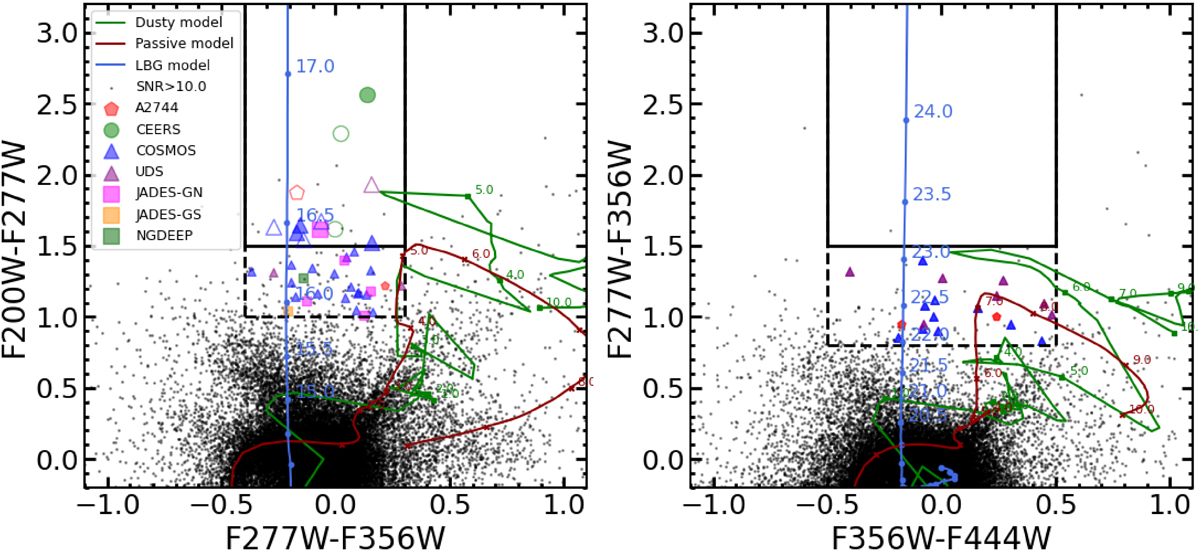
Observed colour selection diagrams for LBGs at z ∼ 15 − 20 (left) and z ∼ 20 − 30 (right). The black continuous lines enclose the region, where ‘reference’ samples are selected. Large, filled markers show the position of the objects selected from the various fields, while the seven selected interlopers are shown as open symbols: CEERS-93316 (Arrabal Haro et al. 2023b), the transient A2744_27713, and the five objects observed with NIRSpec PRISM by the CAPERS survey (Sect. 4.3). Small markers show the position of candidates in the ‘extended’ samples selected within the colour region enclosed by dashed lines. Objects detected at S/N > 10 at any redshift in the JADES-GS field are shown as black points to highlight the parameter space where the bulk of ASTRODEEP-JWST objects are found. The coloured tracks mark the expected colours of stellar plus nebular BC03 templates at the different redshifts indicated by the relevant labels: high-redshift star-forming galaxies at z ≥ 10 with an age = 20 Myr, Z = 0.02 Z⊙, and E(B − V) = 0 (blue); passively evolving galaxies at 0 ≤ z ≤ 10 with Z = 0.2 Z⊙ formed with an instantaneous burst at z = 15 (dark red); dusty objects at 0 ≤ z ≤ 10 with an age = 100 Myr, Z = 0.2 Z⊙, and E(B − V) = 0.8 (dark green).
Current usage metrics show cumulative count of Article Views (full-text article views including HTML views, PDF and ePub downloads, according to the available data) and Abstracts Views on Vision4Press platform.
Data correspond to usage on the plateform after 2015. The current usage metrics is available 48-96 hours after online publication and is updated daily on week days.
Initial download of the metrics may take a while.