


Fig. 1.
Download original image
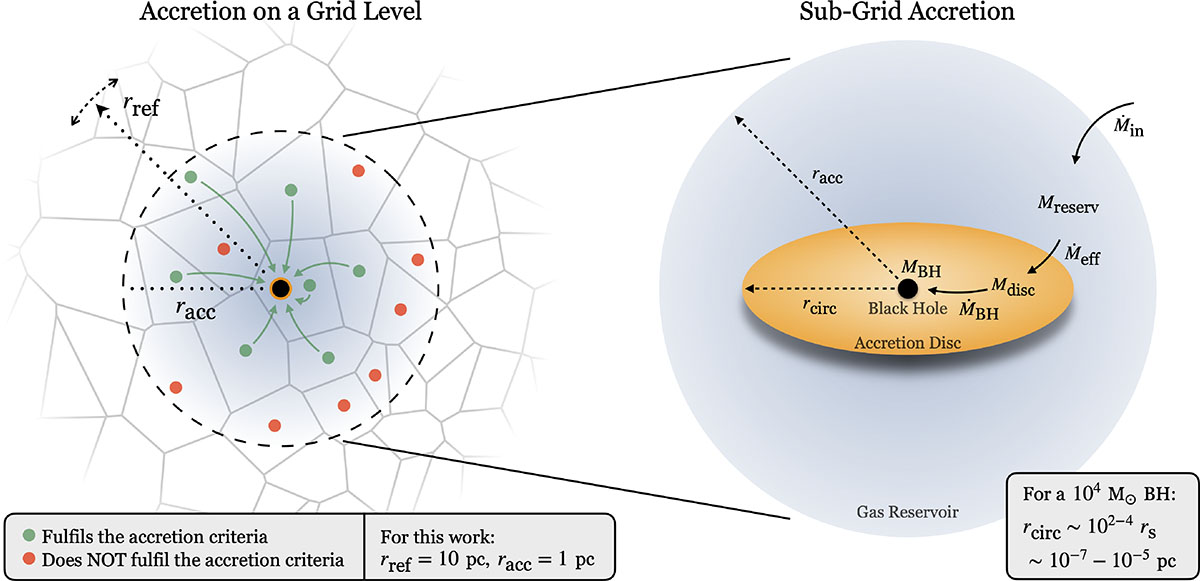
Sketch of how the MBH gas accretion model described in Sect. 2.4 behaves on a (sub-)grid level (including some typical length scales adopted for this work). Left: On a grid level, gas cells inside the refinement radius, rref, and the accretion radius, racc, are geometrically refined to ensure that the accretion region, r < racc, of the MBH is always resolved by at least a few tens of gas cells (see Sect. 2.4.2 for more details). Whenever at least one active gas cell inside the accretion region fulfils the accretion criteria, the code first estimates the infalling gas accretion rate according to Eq. (4), and then skim mass of individual gas cells following Eq. (5). Right: If the infalling gas accretion rate Ṁin > 0.02 ṀEdd (or if ṀBH is already sufficiently high from the previous timestep), the skimmed gas is set to evolve on a sub-grid level. There, it is initially placed into a reservoir from which it is allowed to fall on a free-fall timescale down to the so-called circularisation radius, rcirc (the radius at which an accretion disc is expected to form). Finally, the gas is accreted onto the MBH on a viscous timescale (see Eq. 7), assuming a geometrically thin, optically thick accretion disc. When Ṁin < 0.02 ṀEdd, the accretion timescale is expected to be very short (compared to the viscous timescale); thus, no time-lag effects are considered. Instead, the skimmed gas is directly accreted onto the MBH (see Sect. 2.4.1 for more details).
Current usage metrics show cumulative count of Article Views (full-text article views including HTML views, PDF and ePub downloads, according to the available data) and Abstracts Views on Vision4Press platform.
Data correspond to usage on the plateform after 2015. The current usage metrics is available 48-96 hours after online publication and is updated daily on week days.
Initial download of the metrics may take a while.