


Fig. 1
Download original image
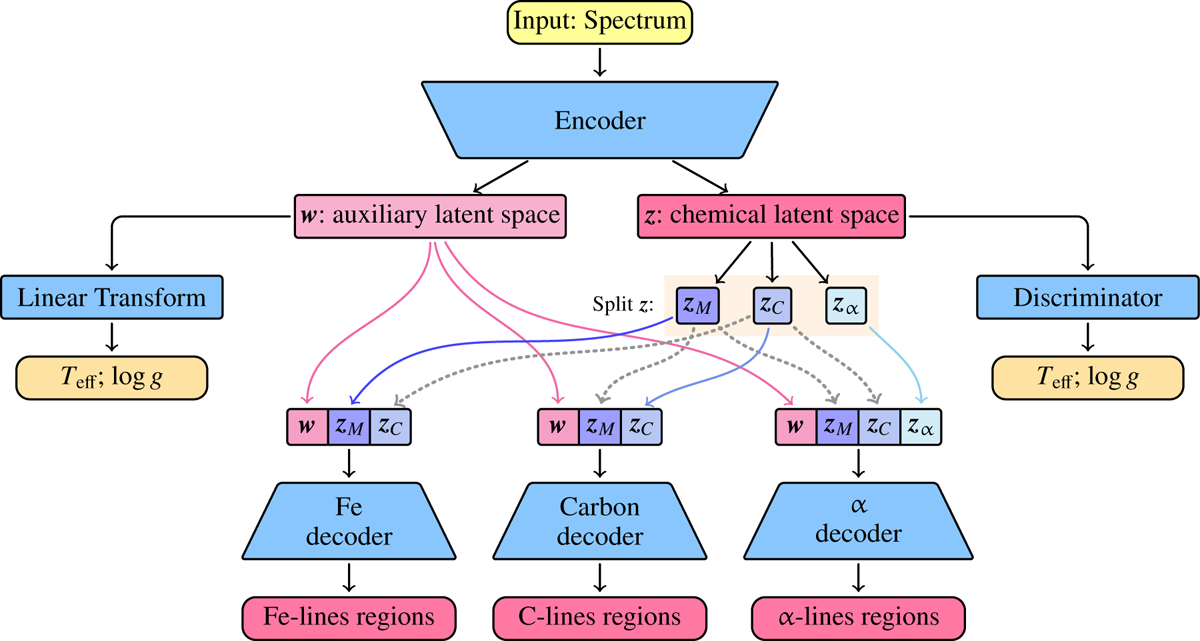
Main model. A spectrum is given as input. An encoder maps it to the latent space, divided into chemical latent space z=(zM, zC, zα), and auxiliary latent space w. Three decoders map different components of z, along with w, to separate regions of the input spectrum. A linear transform is applied to the auxiliary space to obtain (Teff, log g). The discriminator is trained to predict the nonchemical parameters (Teff, log g) from z, while the encoder is trained to make this impossible for the discriminator to predict these parameters from z alone. The dotted gray arrows represent the absence of gradient propagation (see Sect. 2.4). At inference time the decoders, the discriminator and the linear transform module are discarded.
Current usage metrics show cumulative count of Article Views (full-text article views including HTML views, PDF and ePub downloads, according to the available data) and Abstracts Views on Vision4Press platform.
Data correspond to usage on the plateform after 2015. The current usage metrics is available 48-96 hours after online publication and is updated daily on week days.
Initial download of the metrics may take a while.