


Fig. 4.
Download original image
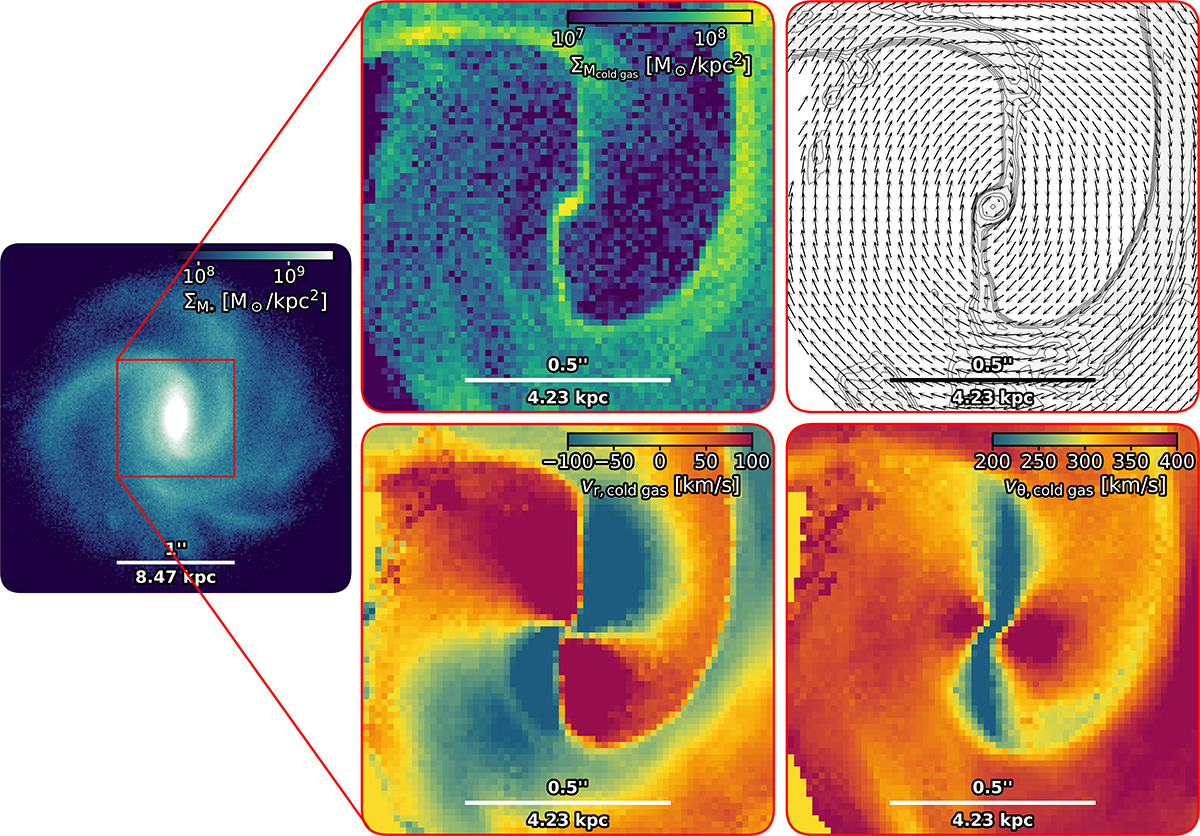
Simulation: Face-on surface density of the stellar component (left) and the cold gas surface density (top middle), in-plane velocity field (top right), amplitude of radial (bottom middle), and tangential (bottom right) velocities. The bar is clearly discernible as an elongated structure in the stellar component, while two narrow regions of increased gas surface density, i.e., dust lane shocks or bar lanes, are located at the leading side of the bar. The identified gas flows in this gas-rich barred galaxy are in agreement with theoretical expectations; gas gets shocked at the loci of the bar lanes formed ahead, with respect to the direction of rotation, of the potential minimum, i.e., the major axis of the bar, loses angular momentum and gets funneled toward the center of the galaxy. This pattern is reflected in the radial and tangential components of the in-plane velocities, with a characteristic quadrupole pattern in the former and slower (faster) rotation along the major (minor) axis of the bar in the latter.
Current usage metrics show cumulative count of Article Views (full-text article views including HTML views, PDF and ePub downloads, according to the available data) and Abstracts Views on Vision4Press platform.
Data correspond to usage on the plateform after 2015. The current usage metrics is available 48-96 hours after online publication and is updated daily on week days.
Initial download of the metrics may take a while.