


Fig. 7.
Download original image
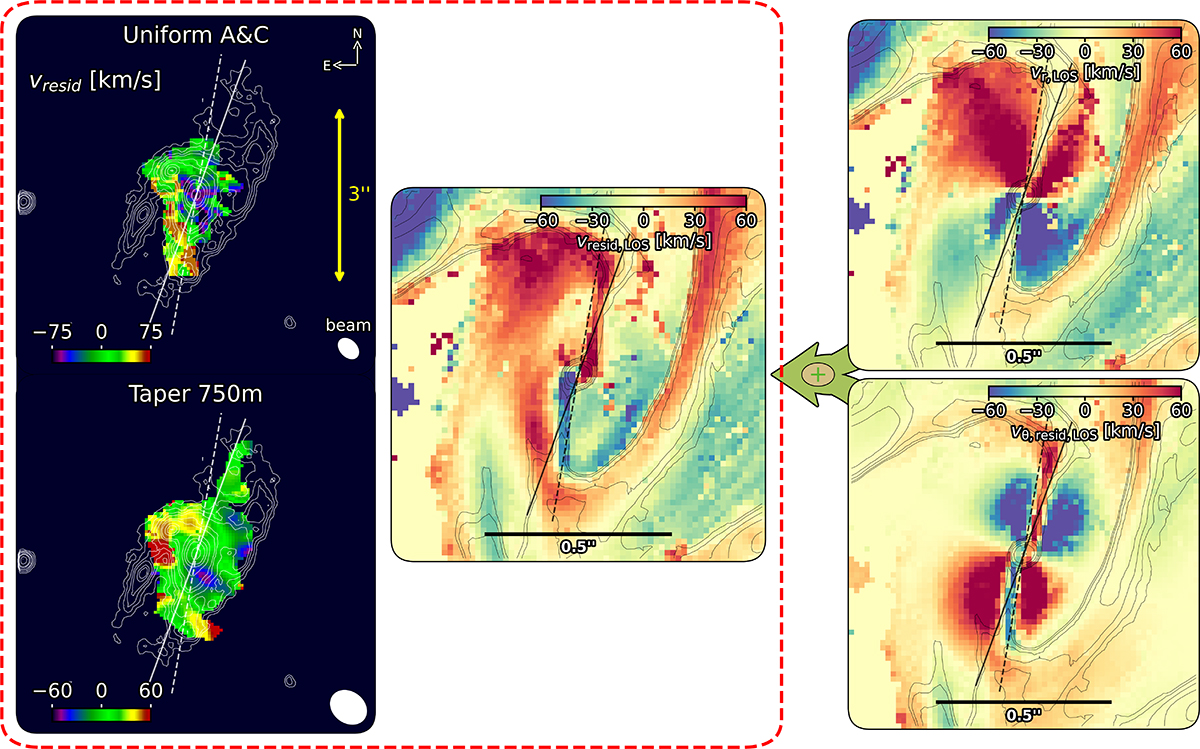
Comparison between the observed LOS velocity residuals (top and bottom left) and the expected residuals from the simulation (middle), derived as the combined LOS contribution of the radial (top right), and residual tangential (bottom left) planar velocities. The solid and dashed lines indicate the PA of the galaxy and the bar, respectively. There is an apparent qualitative agreement between the simulated and observed residual patterns. Our high-resolution uniformly weighted data capture in detail the gas streaming motions on the southern part of the bar, with respect to the center of the galaxy, while the tapered weighted data enable the additional identification of the outflows at its northern trailing part (and possibly the effect of the northern dust lane shock at the leading one). Insights from the in-plane radial and tangential LOS contributions uncover the nature of planar flows in GN4_32842: faster (slower) azimuthal streaming along the minor (major) axis of the bar, outflows at the trailing side of its major axis, and inflows at the leading one with their observational signatures being damped due to their proximity to the kinematic major axis and opposite contributions stemming from faster azimuthal streaming.
Current usage metrics show cumulative count of Article Views (full-text article views including HTML views, PDF and ePub downloads, according to the available data) and Abstracts Views on Vision4Press platform.
Data correspond to usage on the plateform after 2015. The current usage metrics is available 48-96 hours after online publication and is updated daily on week days.
Initial download of the metrics may take a while.