


Fig. 6
Download original image
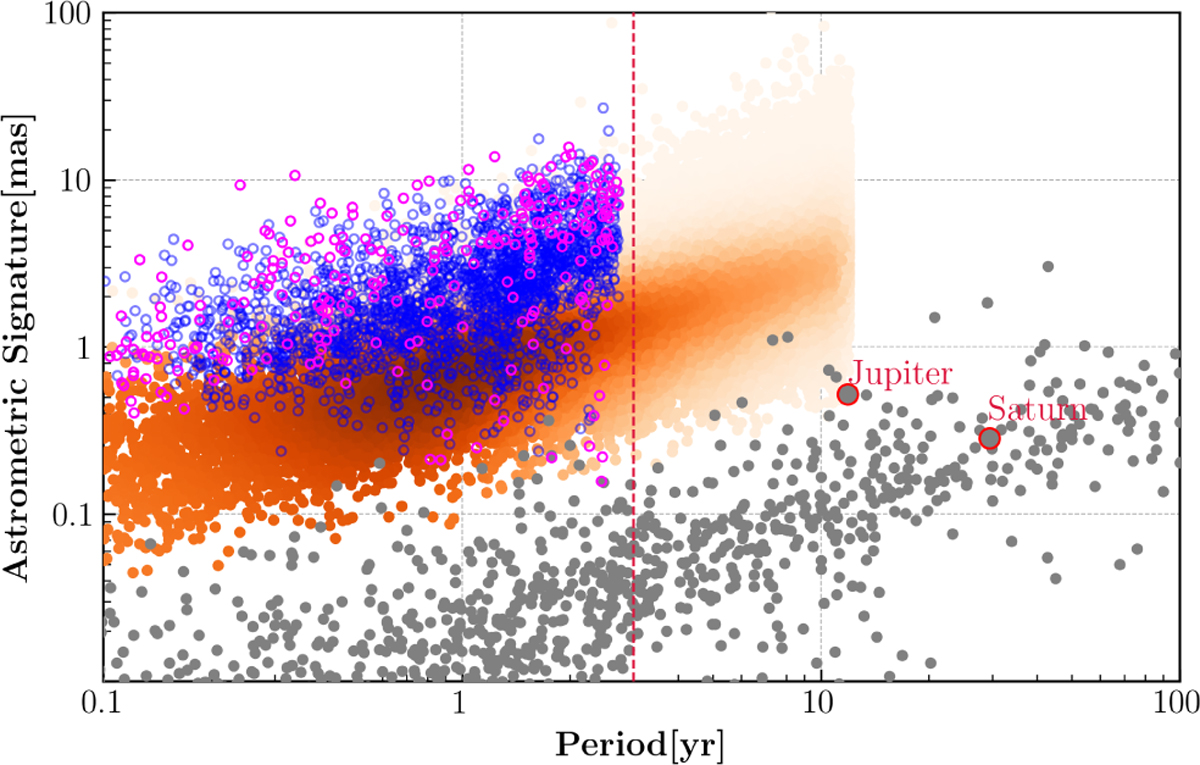
Astrometric signature vs. orbital period for the simulated binary sources (orange), the 384 DR3 NSS ORBT solutions (magenta), the 1332 DR3 NSS ASB1 solutions (blue) and the currently confirmed exoplanets (Schneider et al. 2011) (gray). The red dashed vertical line represents the DR3 time baseline of 34 months in comparison to the shorter periods of the Gaia DR3 unresolved binary orbital solutions. For the DR3 NSS solutions we used the expression α=a0/d to compute the astrometric signature. a0 was computed using the Thiele-Innes elements (A, B, F, G) of the corresponding Gaia DR3 NSS solution and the recipe available in Halbwachs et al. (2023, Appendix A), and d was computed as the inverse of the source parallax. For the simulated sources we used α=M2/M1 × a1/d from Perryman et al. (2014), where M1 and M2 are the primary and secondary masses, respectively, and a1 is the semimajor axis of the orbit of the secondary.
Current usage metrics show cumulative count of Article Views (full-text article views including HTML views, PDF and ePub downloads, according to the available data) and Abstracts Views on Vision4Press platform.
Data correspond to usage on the plateform after 2015. The current usage metrics is available 48-96 hours after online publication and is updated daily on week days.
Initial download of the metrics may take a while.