


Fig. 7.
Download original image
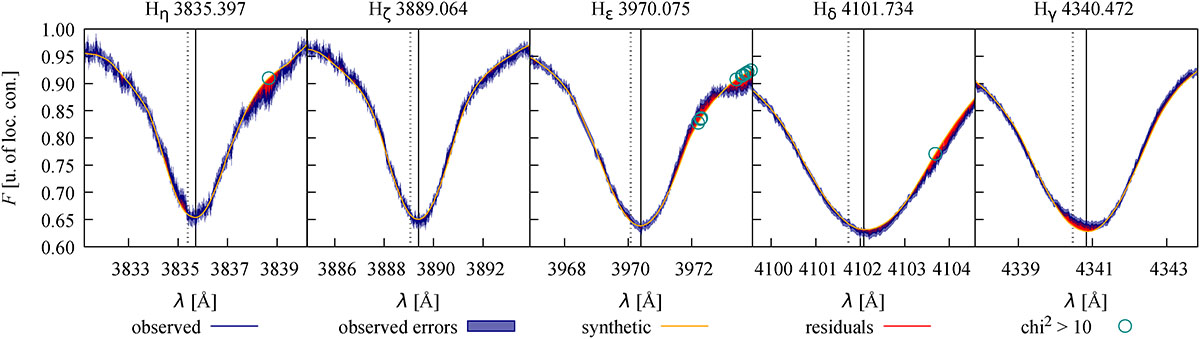
Almost spherical model of ε Ori based on CFHT spectroscopy. Hydrogen Balmer lines were fitted using 1443 data points, excluding Hα and Hβ, which are ‘filled’ by wind-induced emission. An interstellar calcium 3968 Å for Hε was masked. The best fit resulted in χSPE2 = 1770. Free parameters were Prot = 4.551 d, T = 25 037 K, log g = 3.016, i = 21.40 deg, and γ = 25.00 km s−1. Other parameters were fixed and set according to interferometry. The derived parameters were v sin i = 111 km s−1 and v = 305 km s−1. The dotted lines show laboratory wavelengths, while the solid vertical lines indicate the Doppler-shifted line centres, corresponding to the resulting γ. The teal circles denote the points that contributed to χ2 with values greater than 10. This model explains reasonably well the Balmer lines, with a few systematics remaining in Hε, Hη, possibly due to different metal abundances. The temperature was constrained, and log g was slightly adjusted. However, due to the difference in inclination (i = 21 vs 62 deg), the interferometric model would become worse, with χVIS2 = 16.04. The fit of He I lines is given in Fig. C.5.
Current usage metrics show cumulative count of Article Views (full-text article views including HTML views, PDF and ePub downloads, according to the available data) and Abstracts Views on Vision4Press platform.
Data correspond to usage on the plateform after 2015. The current usage metrics is available 48-96 hours after online publication and is updated daily on week days.
Initial download of the metrics may take a while.