


Fig. 3.
Download original image
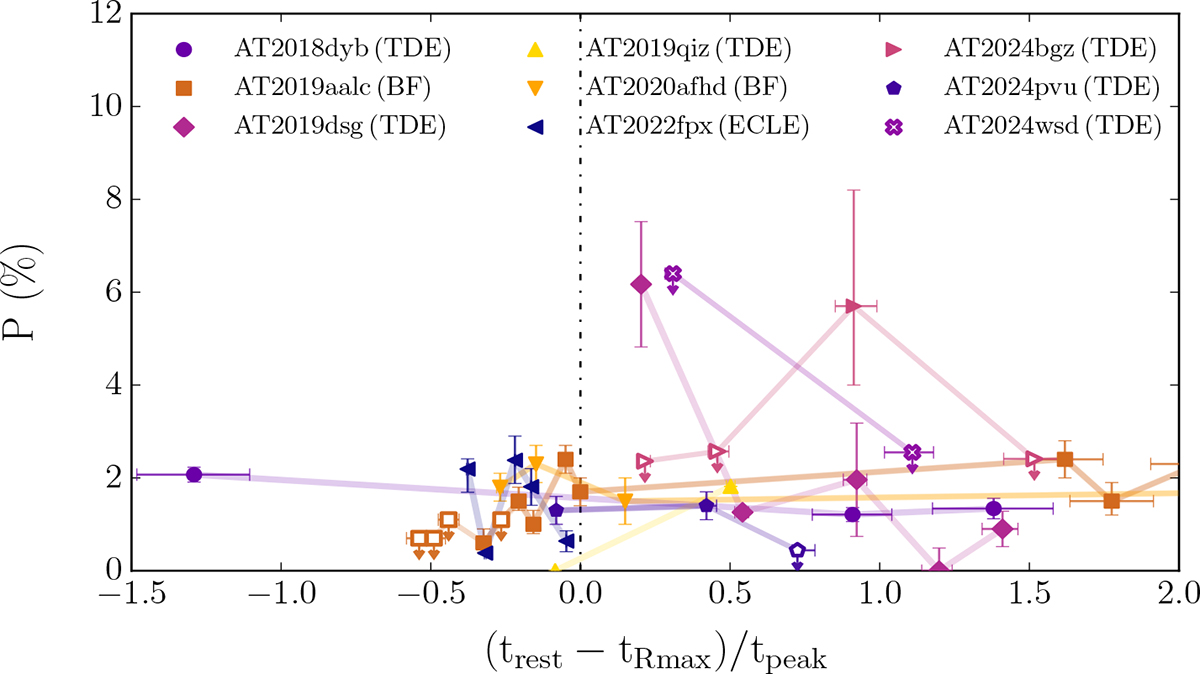
Rest-frame polarisation measurements of thermal TDEs (Patra et al. 2022; Leloudas et al. 2022), BFs, and the extreme coronal line emitter AT2022fpx (Koljonen et al. 2024). Time is scaled by each event’s rise time to peak bolometric luminosity to remove the primary timing dependencies on SMBH and stellar mass (i.e.  ). Here, the tRmax is the epoch at which the MOSFiT-derived blackbody radius (and, to a good approximation, the bolometric luminosity) reaches its maximum. Polarisation measurements at Δt/tpeak < 0 correspond to the optically thick expansion regime of the electron-scattering photosphere, where polarisation reflects the asymmetry of the outermost layers. The dotted line at Δt/tpeak = 0 marks the photospheric turnover at Δt/tpeak > 0, where the photosphere recedes as the ejecta become increasingly more optically thin. This allows asymmetries in the inner ejecta to become more apparent in their polarisation imprint. Note that AT2019qiz is corrected by an estimation of host depolarisation using ZTF data and assuming Phost ≈ 0%. Within our sample, measurements with Pobs/σP < 3 are reported as 2σ upper limits (empty markers).
Current usage metrics show cumulative count of Article Views (full-text article views including HTML views, PDF and ePub downloads, according to the available data) and Abstracts Views on Vision4Press platform.
Data correspond to usage on the plateform after 2015. The current usage metrics is available 48-96 hours after online publication and is updated daily on week days.
Initial download of the metrics may take a while.