


Fig. 1.
Download original image
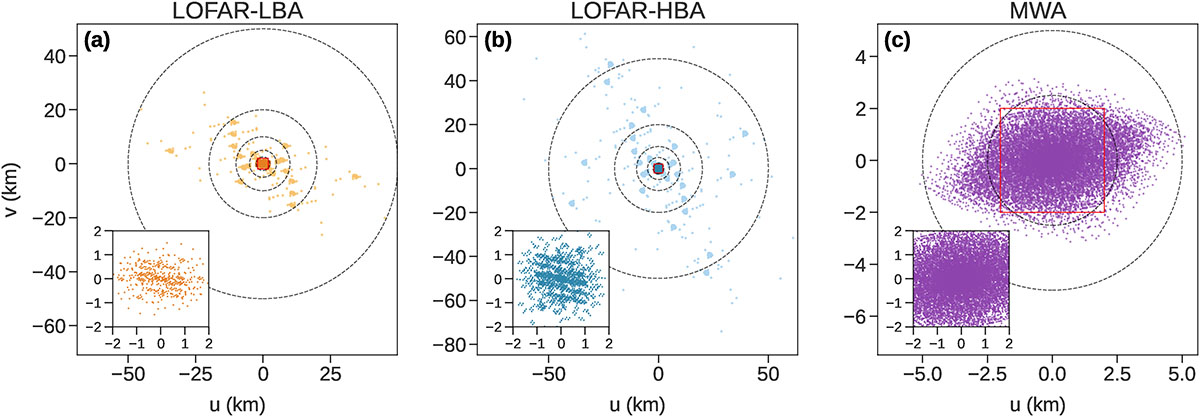
Instantaneous uv-coverage comparison between the LOw Frequency ARray (LOFAR) and the Murchison Widefield Array (MWA). Projected baseline distributions are shown for (a) LOFAR-LBA, (b) LOFAR-HBA, and (c) the MWA Phase-II configuration. Both LOFAR-LBA and HBA exhibit densely clustered cores, providing high sensitivity to large-scale solar structures, complemented by longer remote baselines that enable higher spatial resolution. In contrast, the MWA provides a significantly denser and more uniformly distributed uv-coverage within a compact footprint, facilitating high-fidelity snapshot imaging at moderate resolution (a few arcminutes). Insets in each panel zoom into the central ±2 km region (marked by red squares) to highlight baseline distributions within the core. The dashed black circles indicate radii of 2.5, 5, 10, 20, and 50 km. The number of independent baselines from core antennas is 276 for LOFAR-LBA and 1128 for LOFAR-HBA. For panel c, representing the MWA phase-II configuration, there are 8128 instantaneous baselines within 5 km.
Current usage metrics show cumulative count of Article Views (full-text article views including HTML views, PDF and ePub downloads, according to the available data) and Abstracts Views on Vision4Press platform.
Data correspond to usage on the plateform after 2015. The current usage metrics is available 48-96 hours after online publication and is updated daily on week days.
Initial download of the metrics may take a while.