


Fig. 7
Download original image
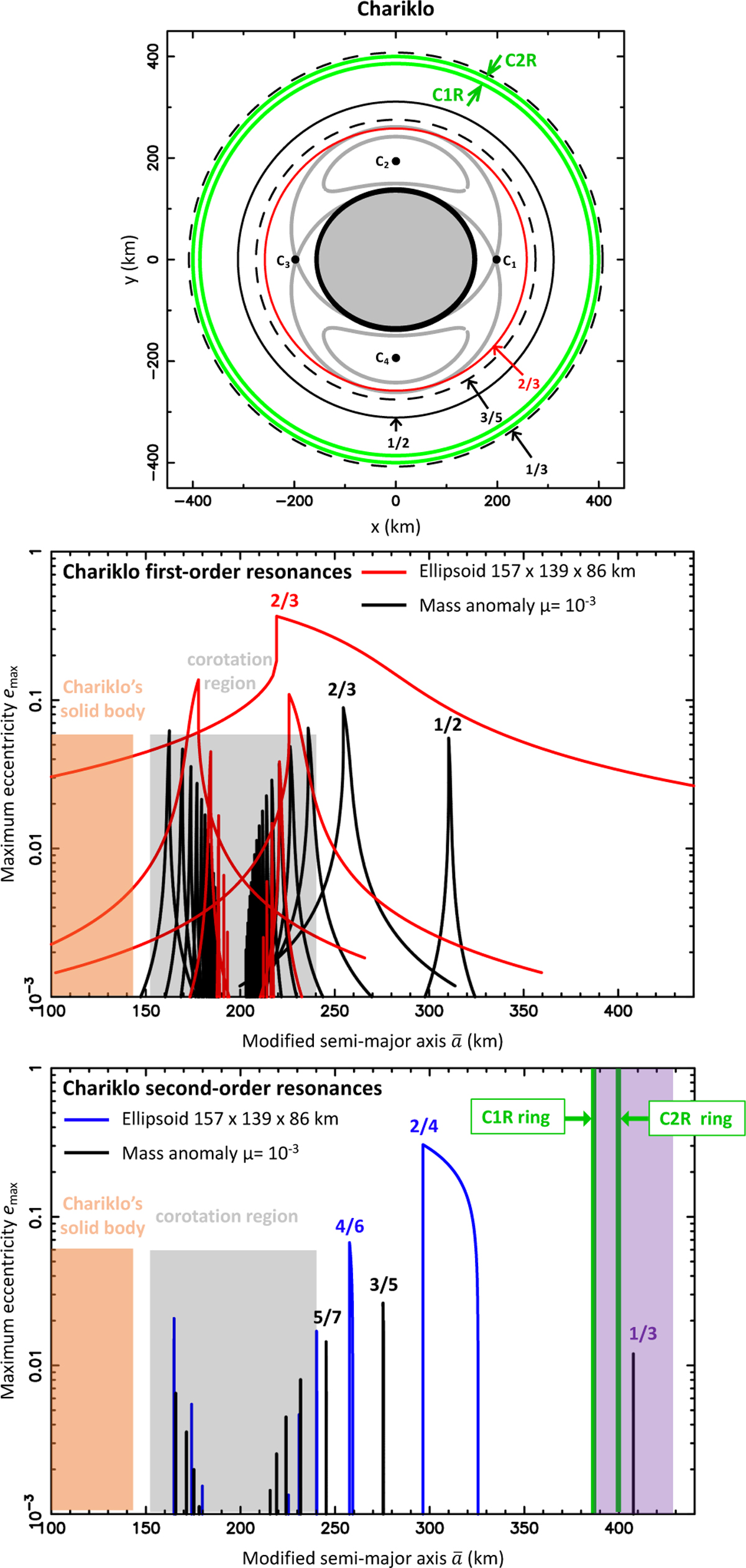
Resonances around Chariklo. Upper panel: trajectories (shown by light gray lines) around the corotation points, C2 and C4, of Chariklo, using Eq. (F.3). The dark gray ellipse is a pole-on view of Chariklo’s shape, taken from Table 2. The two green circles mark the radii of C1R and C2R rings. Red circle: First-order 2/3 resonance caused by Chariklo’s triaxial shape. Solid black circle: first-order 1/2 resonances caused by a mass anomaly. Dashed black circle: second-order 1/3 and 3/5 resonances caused by a mass anomaly. More resonances radii are plotted in the lower panels. Middle panel: maximum eccentricity, emax (in log-scale), reached by a particle initially on a circular orbit, reproducing the behavior displayed in Fig. 3 for each SOR. Red curves: SORs caused by the triaxial shape of Chariklo. Black curves: SORs caused by a mass anomaly, µ = 10−3. The orange box indicates Chariklo’s largest semi-axis, while the gray box shows the radial extension of the corotation zone, i.e., the full width of the corotation resonance (Eq. (F.4)). Lower panel: same, but for second-order resonances. The radii of the rings C1R and C2R are marked in green. The purple zone is the uncertainty on the 1/3 SOR location, due to the uncertainty on Chariklo’s mass. The uncertainties on the ring radii are negligible at this scale (see Table 2).
Current usage metrics show cumulative count of Article Views (full-text article views including HTML views, PDF and ePub downloads, according to the available data) and Abstracts Views on Vision4Press platform.
Data correspond to usage on the plateform after 2015. The current usage metrics is available 48-96 hours after online publication and is updated daily on week days.
Initial download of the metrics may take a while.