


Table D.3.
Inferred system parameters.
| Parameter | Units | Prior | Median and 68.3% CI | ||
|---|---|---|---|---|---|
| Star | |||||
| Stellar mass, M★ | (M⊙) | N(1.053, 0.068) | 1.063 ± 0.065 | ||
| Stellar radius, R★ | ( ) ) |
N(1.030, 0.046) | 1.035 ± 0.026 | ||
| Stellar mean density, ρ★ | (g cm−3) |
 |
|||
| Surface gravity, log g | (cgs) |  |
|||
| Planets | Planet b | Planet c | Planet d | ||
| Semi-major axis, a | (au) | 0.1019 ± 0.0020 | 0.1595 ± 0.0032 | 0.2672 ± 0.0053 | |
| Eccentricity, e | 0.0572 ± 0.0033 |  |
0.040 ± 0.022 | ||
| Argument of periastron, ω | (°) | 95.9 ± 5.6 |  |
338 ± 37 | |
| Inclination, i | (°) | S(0, 180)b, c, S(0, 90)d | 90.03 ± 0.72 | 90.11 ± 0.34 |  |
| Longitude of the ascending node, Ω | (°) | U(90, 270)b, d | 180.0 ± 1.8 | 180 (fixed at tref) | 179.63 ± 0.42 |
| Mean anomaly, M0 | (°) | 116.2 ± 5.0 |  |
170 ± 39 | |
 |
U(−1, 1) |  |
 |
0.155 ± 0.081 | |
 |
U(−1, 1) | 0.2372 ± 0.0052 | −0.011 ± 0.040 | −0.073 ± 0.098 | |
| Mass ratio, Mp/M★ | U(0, 1) | (5.12 ± 0.36)×10−5 | (36.9 ± 2.3)×10−5 | (53.5 ± 4.6)×10−5 | |
| Radius ratio, Rp/R★ | U(0, 1) | 0.06480 ± 0.00098 | 0.09578 ± 0.00092 | 0.0933 ± 0.0011 | |
| Scaled semi-major axis, a/R★ |  |
 |
 |
||
| Impact parameter, b | 0.18 ± 0.13 | 0.14 ± 0.13 | 0.681 ± 0.026 | ||
| T0′-2450000 | (BJDTDB) | U(8386, 10386) | 9382.5322 ± 0.0016 | 9386.4191 ± 0.0011 | 9377.8713 ± 0.0021 |
| P′ | (d) | U(0, 1000) | 11.52195 ± 0.00090 | 22.5617 ± 0.0031 | 48.9176 ± 0.0047 |
| K′ | (m s−1) | 4.93 ± 0.36 | 28.4 ± 1.9 | 31.8 ± 2.8 | |
| Planet mass, Mp | (ME) | 18.1 ± 1.7 | 131 ± 11 | 190 ± 20 | |
| (MJ) | 0.0571 ± 0.0052 | 0.412 ± 0.036 | 0.597 ± 0.064 | ||
| Planet radius, Rp | ( ) ) |
7.31 ± 0.23 | 10.81 ± 0.32 | 10.52 ± 0.32 | |
( ) ) |
0.652 ± 0.020 | 0.964 ± 0.029 | 0.939 ± 0.029 | ||
| Planet mean density, ρp | (g cm−3) | 0.255 ± 0.026 | 0.573 ± 0.062 | 0.89 ± 0.11 | |
| Planet surface gravity, log gp | (cgs) | 2.521 ± 0.039 | 3.042 ± 0.043 | 3.224 ± 0.049 | |
| Equilibrium temperature, Teq | (K) | 878 ± 13 | 702 ± 10 | 542.4 ± 7.8 | |
| Mutual inclination, Ib, c | (°) |  |
|||
| Mutual inclination, Ic, d | (°) | 0.97 ± 0.39 | |||
| RV | |||||
| Coralie jitter | U(0, 10) | 0.79 ± 0.14 | |||
| Coralie offset | [m s−1] | U(−105, 105) | 13675.5 ± 3.9 | ||
| Linear ephemerides | |||||
| Period | (d) | 11.5308690 | 22.5687423 | 48.8644680 | |
| T0-2450000 | (BJDTDB) | 8656.213656 | 8664.157045 | 8693.788019 |
Notes. The table lists: Prior, posterior median, and 68.3% credible interval (CI) for the photodynamical analysis (Sect. C). The Jacobi orbital elements are given for the reference time tref = 2 459 386.419785 BJDTDB. The planetary equilibrium temperature is computed for zero albedo and full day-night heat redistribution. P′ and T0′ should not be confused with the linear ephemeris, and they were only used to reduce the correlations between jump parameters, replacing the semi-major axis and the mean anomaly at tref. The linear ephemerides are derived from the median posterior transit times spanning the years 2019 to 2026.  with
with ![$ E=2\arctan{\left\{\sqrt{\frac{1-e}{1+e}}\tan{\left[\frac{1}{2}\left(\frac{\pi}{2}-\omega\right)\right]}\right\}} $](/articles/aa/full_html/2025/12/aa57359-25/aa57359-25-eq34.gif) ,
,  ,
, 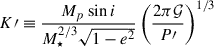 . CODATA 2018: 𝒢 = 6.674 30 × 10−11 m3 kg−1 s−2. IAU 2012: au = 149 597 870 700 m. IAU 2015:
  = 6.957 × 10⁸ m,
  = 1.327 124 4 ×10²⁰
m3 s−2,
= 1.327 124 4 ×10²⁰
m3 s−2,  = 6.378 1 ×10⁶ m,
  = 3.986 004 ×1014
m3 s−2,
= 3.986 004 ×1014
m3 s−2,  = 7.149 2 × 10⁷ m,
  = 1.266 865 3 × 10¹⁷ m3 s−2.
  ,
,  ,
,  ,
,  . N(μ, σ): Normal distribution with mean μ and standard deviation σ. U(a, b): A uniform distribution defined between a lower a and upper b limit. S(a, b): A sinusoidal distribution defined between a lower a and upper b limit.
Current usage metrics show cumulative count of Article Views (full-text article views including HTML views, PDF and ePub downloads, according to the available data) and Abstracts Views on Vision4Press platform.
Data correspond to usage on the plateform after 2015. The current usage metrics is available 48-96 hours after online publication and is updated daily on week days.
Initial download of the metrics may take a while.