


Fig. 1
Download original image
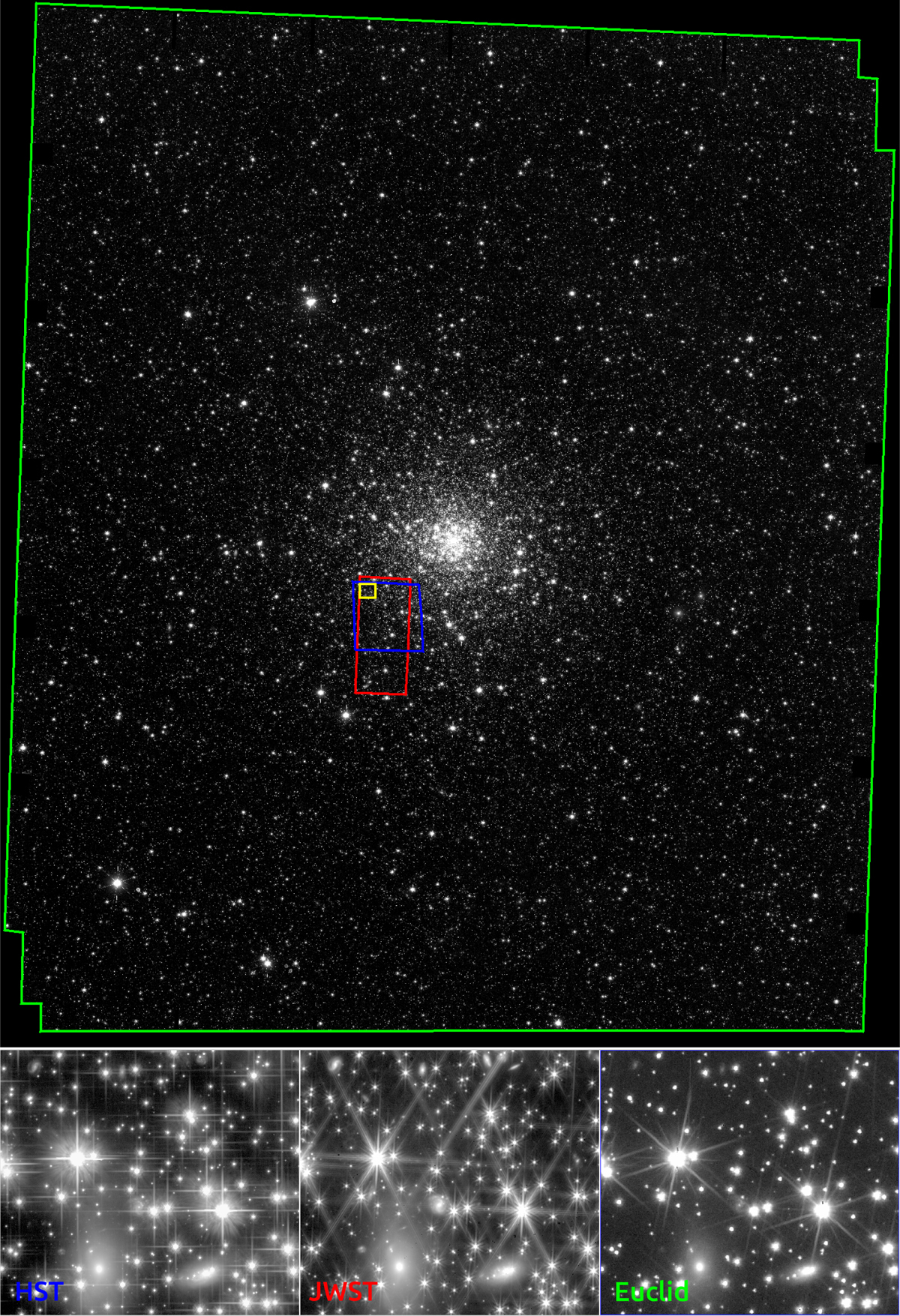
Comparison of imaging depth and resolution from different space observatories. On top are Euclid VIS observations of the globular cluster NGC 6397 combined by Libralato et al. (2024). While both HST and JWST achieve substantially greater imaging depths than Euclid in these specific datasets (HST large program GO-10424 and JWST program GO-1979), the angular resolution of Euclid is comparable to that of HST and JWST, enabling high-precision morphological studies over a considerably larger survey area. The Euclid ~1° × 1° field of view presented in L24 is shown in green, the JWST ∼2.5′×6′ field studied by Bedin et al. (2021, 2024, program GO-1979) in red, and the HST ~3′×3′ field from program GO-10424 in blue. The yellow region of about 50′′ ×50′′ in the top panel is common to the three datasets, which are shown individually in the bottom panels with observatories labelled according to the same colour code. [Images and catalogues available here: HST & JWST and Euclid].
Current usage metrics show cumulative count of Article Views (full-text article views including HTML views, PDF and ePub downloads, according to the available data) and Abstracts Views on Vision4Press platform.
Data correspond to usage on the plateform after 2015. The current usage metrics is available 48-96 hours after online publication and is updated daily on week days.
Initial download of the metrics may take a while.