


Fig. 9
Download original image
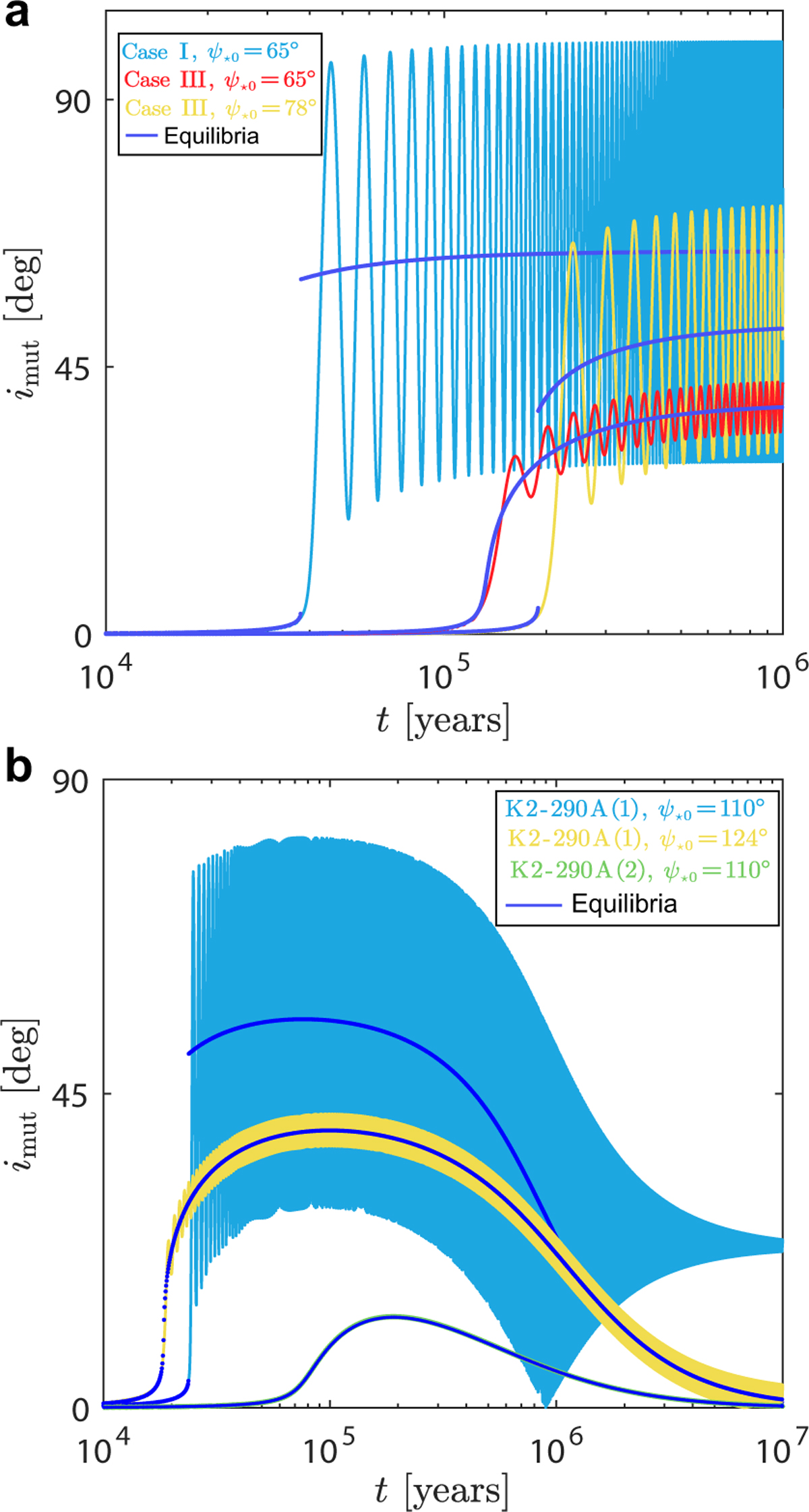
Evolution of orbital inclinations between inner and outer orbits for hierarchical three-body systems obtained by integrating the secular equations for circular orbits. The system parameters are detailed in Table 1. We set the timescale of the disk dissipation (τd) to 1 × 10⁴ yr. In (a), the decay of host stellar oblateness is not considered. In (b), the oblateness of the host star decays due to its radius contraction: R⋆ = R⋆ (0)/(1 + t/τR⋆)−1/3, where τR⋆ = 1 Myr. The temporal evolution of the equilibrium that dominates the planet’s evolution is depicted for each system. Notably, a jump in the equilibrium trajectory signifies an encounter with bifurcation B2.
Current usage metrics show cumulative count of Article Views (full-text article views including HTML views, PDF and ePub downloads, according to the available data) and Abstracts Views on Vision4Press platform.
Data correspond to usage on the plateform after 2015. The current usage metrics is available 48-96 hours after online publication and is updated daily on week days.
Initial download of the metrics may take a while.