


Fig. 1.
Download original image
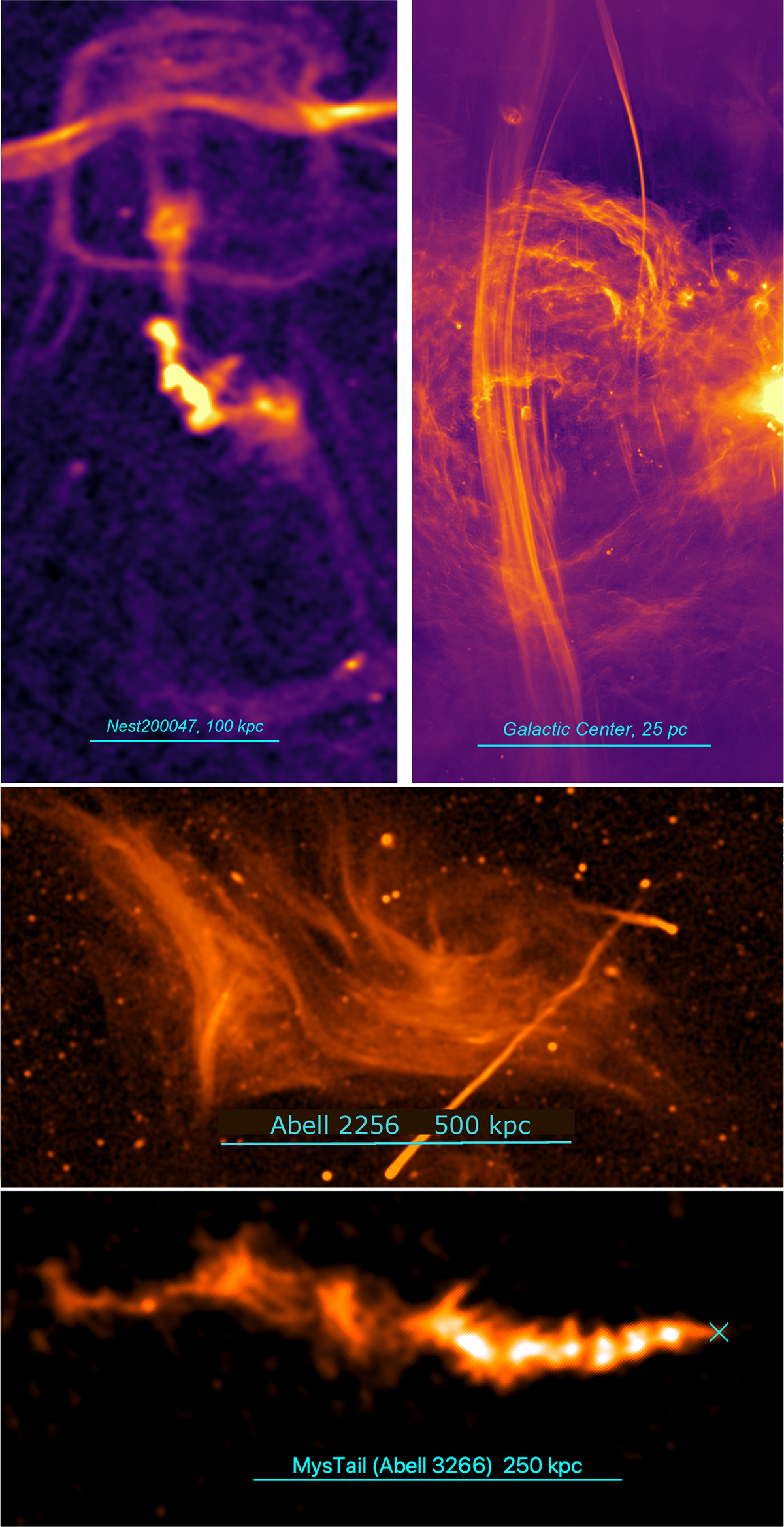
Examples of radio-bright filaments in clusters and the Galactic Center, where fast propagation of relativistic electrons might be important. Top: Core of Nest200047 group, (left, Brienza et al. 2021, LOFAR image at 144 MHz) and the Galactic Center nonthermal filaments (right, Heywood et al. 2019, MeerKAT image at 1.3 GHz). Middle: Peripheral radio relic at the edge of the X-ray halo in Abell 2256 (Owen et al. 2014, VLA image at 1.5 GHz). In all cases, the filaments are long, comparable to the characteristic size of the system. They appear “laminar” and from the polarization measurements in the GC and Abell 2256, the magnetic fields are oriented along the filaments (e.g., Paré et al. 2019; Clarke & Ensslin 2006). In the case of the Galactic Center, we also know that the field is dynamically strong (e.g., Morris 2006). Bottom: Tailed radio galaxy, MysTail in Abell 3266, showing three parallel 40–50 kpc long filaments embedded in the tail. The host position is marked with an “X”.
Current usage metrics show cumulative count of Article Views (full-text article views including HTML views, PDF and ePub downloads, according to the available data) and Abstracts Views on Vision4Press platform.
Data correspond to usage on the plateform after 2015. The current usage metrics is available 48-96 hours after online publication and is updated daily on week days.
Initial download of the metrics may take a while.