


Fig. 4.
Download original image
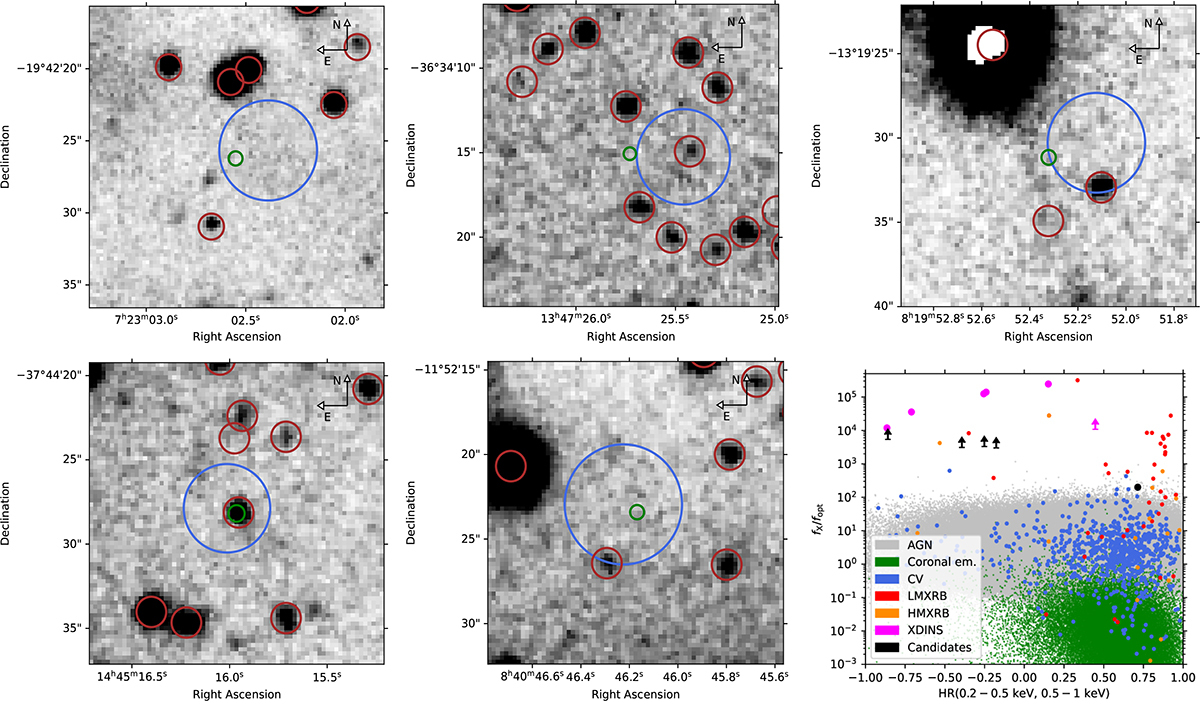
FORS2 R_SPECIAL band finding charts of the fields containing the five INS candidates. We indicate the X-ray sky localisation from XMM-Newton (green; 90% confidence region; Table 2), the X-ray sky position from eROSITA (blue; 90% confidence region; Kurpas et al. 2024a), and the nearby field sources identified from a SExtractor run (brown, arbitrary radii; Bertin & Arnouts 1996). (Bottom right:) X-ray-to-optical flux ratio vs hardness ratio diagram, indicating the five candidates (black markers), the known XDINSs on the western Galactic hemisphere, including the recently discovered candidate eRASSU J131716.9–402647 (magenta; Kurpas et al. 2024b), as well as other soft X-ray emitting sources, namely AGNs (Salvato et al. 2026), coronal emitters (green; Freund et al. 2024), CVs (blue; Ritter & Kolb 2003; Guillochon et al. 2017), low-mass XRBs (red; Avakyan et al. 2023), and high-mass XRBs (orange; Neumann et al. 2023).
Current usage metrics show cumulative count of Article Views (full-text article views including HTML views, PDF and ePub downloads, according to the available data) and Abstracts Views on Vision4Press platform.
Data correspond to usage on the plateform after 2015. The current usage metrics is available 48-96 hours after online publication and is updated daily on week days.
Initial download of the metrics may take a while.