


Fig. 3.
Download original image
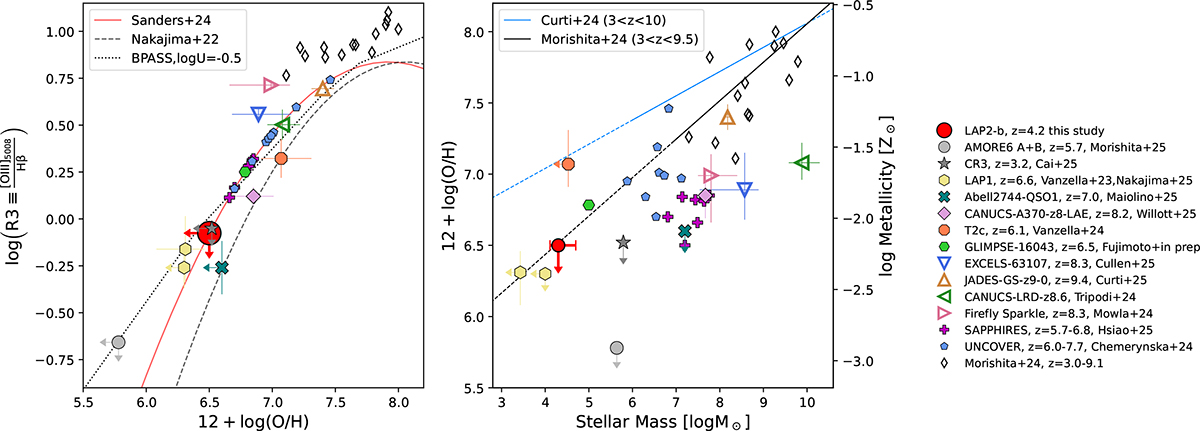
Oxygen abundance of LAP2-b, as function of its R3 index (left panel, 2σ limit is reported) and its stellar mass (right panel). Additional measurements of low-metallicity sources at z > 3 from the literature are reported (Vanzella et al. 2023; Morishita et al. 2024; Chemerynska et al. 2024; Mowla et al. 2024; Tripodi et al. 2025; Vanzella et al. 2024; Hsiao et al. 2025; Curti et al. 2025; Cullen et al. 2025; Willott et al. 2025; Maiolino et al. 2025; Nakajima et al. 2025; Cai et al. 2025; Morishita et al. 2025). Samples plotted with empty markers have their metallicity estimated from the direct Te method, as opposed to the ones derived from strong line ratios (filled markers). The two most common R3-to-Z calibrations used in high-z studies as well as the conversion based on the BPASS models used in Morishita et al. (2025) (dotted black line), are shown in the left panel (see legend). Two recent mass-metallicity relations derived from high-z samples (blue line: Curti et al. 2024; black line: Morishita et al. 2024) are shown in the right panel; the mass ranges used to derive the relations are shown as the solid portion of the line.
Current usage metrics show cumulative count of Article Views (full-text article views including HTML views, PDF and ePub downloads, according to the available data) and Abstracts Views on Vision4Press platform.
Data correspond to usage on the plateform after 2015. The current usage metrics is available 48-96 hours after online publication and is updated daily on week days.
Initial download of the metrics may take a while.