


Fig. 16
Download original image
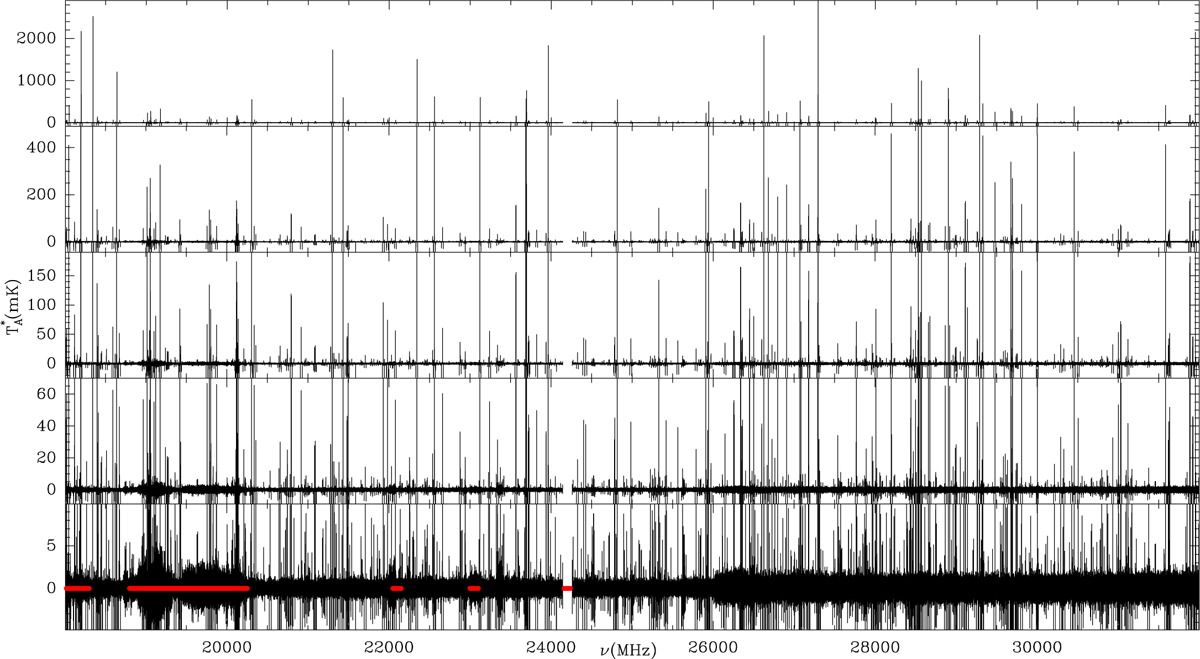
Observed spectrum of TMC-1 in the frequency range 18.0–32.3 GHz using the new K/Ka-band receiver of the 40 m radio telescope of the Yebes Observatory. The data have been gathered in frequency switching. The negative features produced after folding have not been flagged in this figure. The ordinate is the antenna temperature corrected for atmospheric and telescope losses in milli-Kelvin. The different panels show always the same data but with different intensity scales. The abscissa is the rest frequency adopting a local standard of rest velocity (vLSR) of 5.83 km s−1 (Cernicharo et al. 2020a). Observing time in the 18–26 GHz range is 226 hours, while above 26 GHz is only 80 hours. RFI zones are indicated by the red lines in the bottom panel. They correspond to the frequency ranges 18.00–18.30, 18.80–20.25, 22.05–22.15, 23.00–23.10, and 24.15–24.25 GHz. In spite of the strong interferences at these frequencies, intense astronomical lines are easily detected as it can be seen in the different panels.
Current usage metrics show cumulative count of Article Views (full-text article views including HTML views, PDF and ePub downloads, according to the available data) and Abstracts Views on Vision4Press platform.
Data correspond to usage on the plateform after 2015. The current usage metrics is available 48-96 hours after online publication and is updated daily on week days.
Initial download of the metrics may take a while.