


Fig. 13
Download original image
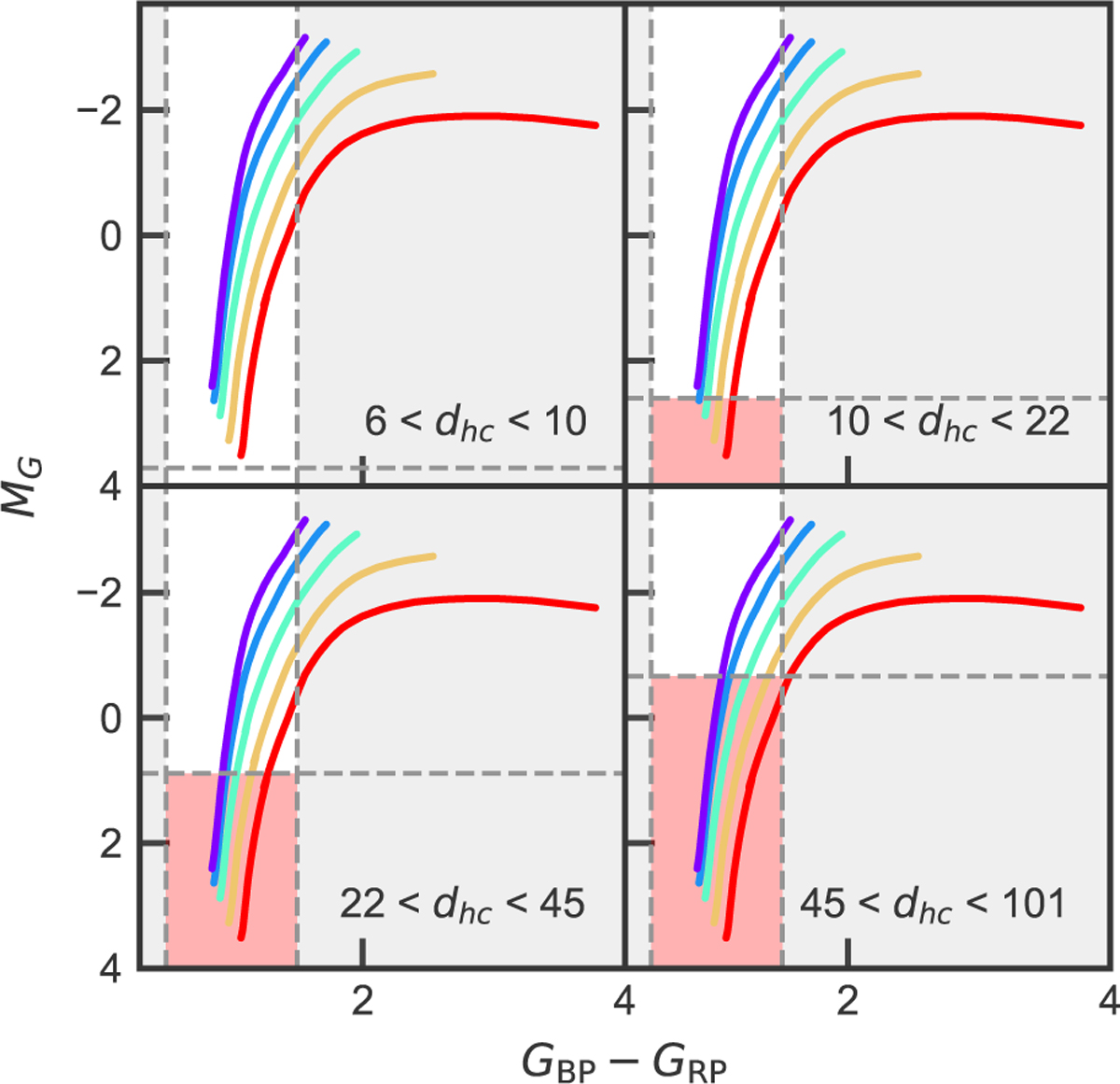
Five PARSEC RGB isochrones with metallicities at −0.25, −0.75, −1.25, −1.75, and −2.25 dex (i.e. centred on the metallicity bins we used for our weights) going from red to purple. The colour range of 0.5 < GBP - GRP < 1.5 is in dashed grey lines and the area that is not probed because of this colour cut is shown in grey. As metallicity increases, the colour cut means that we probe a smaller portion of the RGB, leading to an undersampling of metal-rich stars. We show four panels corresponding to the four most distant bins, given in kpc, where Malmquist bias reduces the range in absolute magnitude probed by each distance bin (where the probed area is seen in white and the area lost due to Malmquist bias is seen in red, the upper limit of which is simply the absolute magnitude of the upper limit of each distance bin). Only the three most distant bins are affected. Note how the most metal-rich isochrone in the 45-101 kpc bin does not enter into the white region at all. The combined effect of the colour and magnitude cut is that the metal-poor stars reach the brightest absolute magnitudes. Therefore, the further into the halo we probe, the smaller the fraction of metal-rich stars.
Current usage metrics show cumulative count of Article Views (full-text article views including HTML views, PDF and ePub downloads, according to the available data) and Abstracts Views on Vision4Press platform.
Data correspond to usage on the plateform after 2015. The current usage metrics is available 48-96 hours after online publication and is updated daily on week days.
Initial download of the metrics may take a while.