


Fig. 11.
Download original image
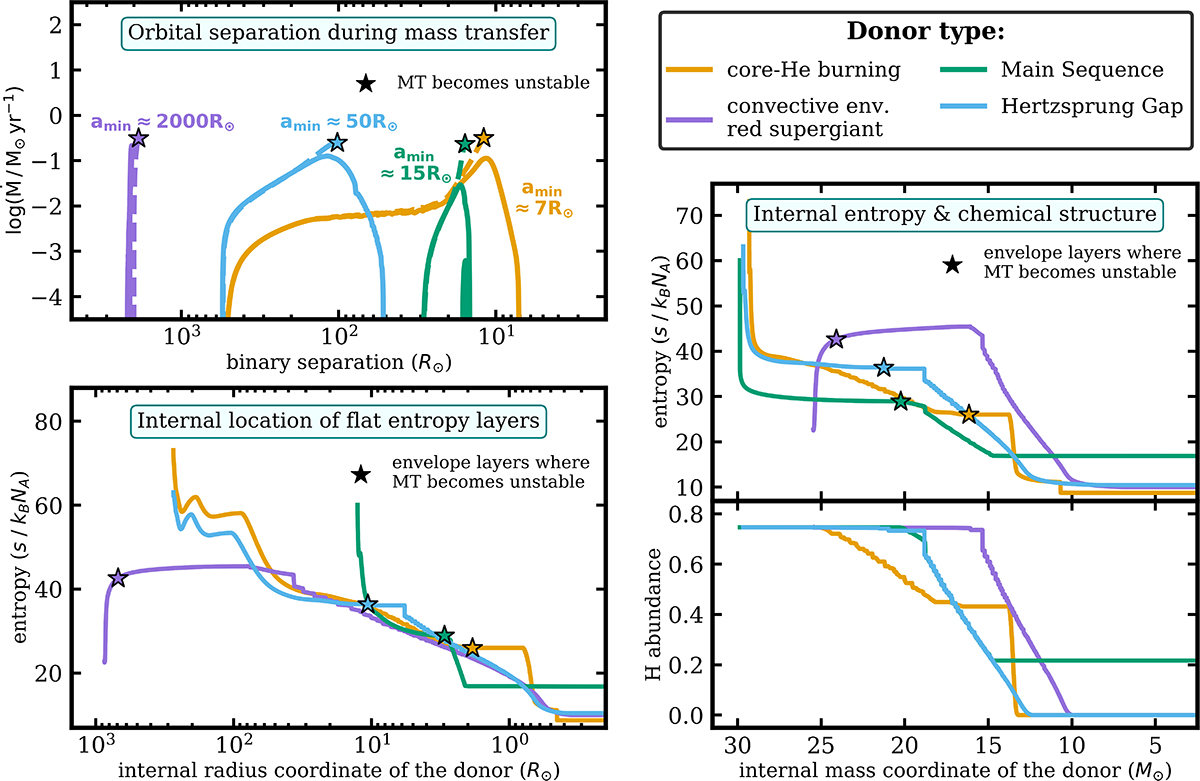
Minimum orbital separation from SMT evolution is different for different types of donor stars. Top left: Evolution of the mass transfer rate (Ṁ) as a function of the decreasing binary separation in interacting systems with a BH accretor and a 30 M⊙ donor of different donor types. The CHeB donor is the same ∼250 R⊙ giant as in Fig. 9, whereas its HG variant comes from the grid with low semiconvection. The solid lines are models at q = qcrit, dashed lines are at q slightly larger than qcrit, such that the MT becomes unstable (star symbols). Right: Internal entropy and H abundance profiles of different donors from the onset of RLOF, plotted as a function of the internal mass coordinate m. The He-core in post-MS donors is at m ≲ 13 M⊙. The layers that cause the Ṁ peak and dynamical instability (star symbols) are where the entropy profile is nearly flat. Bottom left: Same entropy profiles but as a function of the radial coordinate. The difference in the location of the constant entropy regions in the envelopes of different donors is primarily responsible for different minimum orbital separations amin that may be reached via SMT.
Current usage metrics show cumulative count of Article Views (full-text article views including HTML views, PDF and ePub downloads, according to the available data) and Abstracts Views on Vision4Press platform.
Data correspond to usage on the plateform after 2015. The current usage metrics is available 48-96 hours after online publication and is updated daily on week days.
Initial download of the metrics may take a while.