


Fig. 4.
Download original image
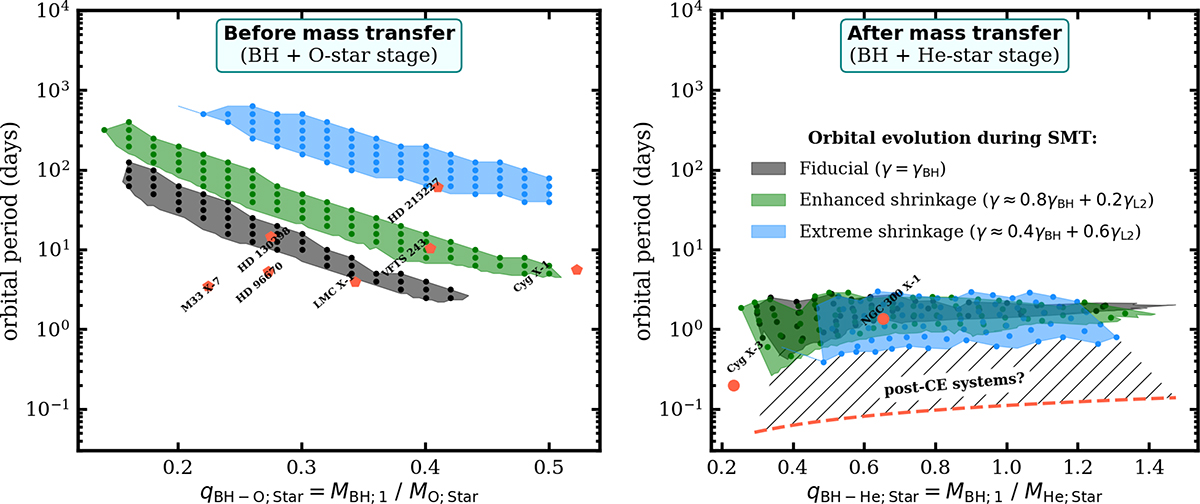
Narrow window in the parameter space for the SMT channel converging to a well-defined narrow range of final orbits regardless of uncertainties in binary physics. We plot the orbital periods of BBH merger progenitors from before the mass transfer (BH+O-star stage, left) and after the SMT phase has taken place (BH+He-star stage, right). The figure is based on grids of detailed binary models with MBH; 1 = 10 M⊙ and varying assumptions on the orbital shrinkage during mass transfer (i.e., γ values, shown in different colors). Changing the assumption on γ significantly shifts the pre-SMT periods of BBH merger progenitors, but has little effect on the post-interaction orbits at the BH+He-star stage (or the properties of BBH mergers). The dashed red line shows the lower limit on the period of a BH+He-star systems, such that the naked helium star does not overflow its Roche lobe. We mark the periods and mass ratios of the known BH+OB-star systems (left panel, including supergiant high mass X-ray binaries) and of BH+Wolf-Rayet X-ray binaries (right). Cyg X-3 cannot be reproduced by SMT in our models, suggesting its origin in CE evolution.
Current usage metrics show cumulative count of Article Views (full-text article views including HTML views, PDF and ePub downloads, according to the available data) and Abstracts Views on Vision4Press platform.
Data correspond to usage on the plateform after 2015. The current usage metrics is available 48-96 hours after online publication and is updated daily on week days.
Initial download of the metrics may take a while.