


Fig. 5.
Download original image
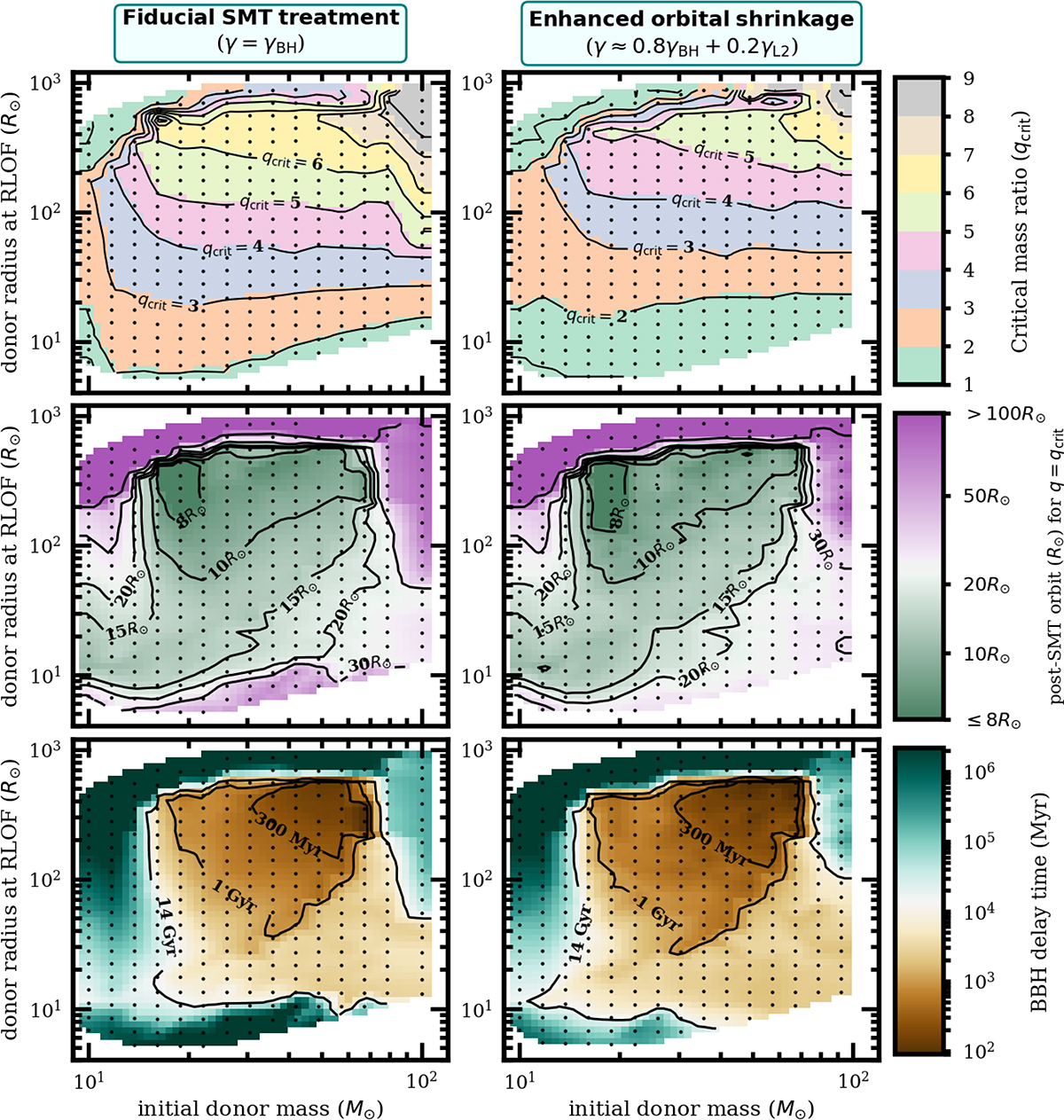
Minimum orbital size from SMT evolution is primarily determined by the donor star, rather than by binary physics. Here, we report the critical mass ratios qcrit for BH+O-star systems (top panels), final orbital separations in binaries with qRLOF = qcrit (middle panels), and their corresponding BBH delay times (bottom panels), calculated with MESA for a grid of donor stars of different mass (at ZAMS) and radius (at the onset of RLOF) at Z = 0.1 Z⊙. The separations and BBH delay times shown here can be viewed as the minimum values achievable from SMT evolution given the donor mass and radius. Left panels follow the fiducial SMT treatment with γ = γBH, right panels assume enhanced orbital shrinkage due to L2 outflows. While enhancing the orbital shrinkage (left vs right) affects the critical mass ratios, the post-SMT orbits and their corresponding BBH delay times remain nearly unchanged. This is because these final outcomes are primarily determined by the stellar structure of the donor, which is the same in both variations. For illustrative purposes, the BBH delay times assume that each donor collapses to form the second BH, no matter its final core mass. Only the systems with delay times below ∼13.7 Gyr (i.e., brown in the bottom panels) are potential BBH mergers and GW sources for the LIGO/Virgo/Kagra detectors. The scatter points indicate the explored grid of donor masses and radii. For each pair, the qcrit value was found iteratively via binary MESA models down to at least ±0.1 accuracy.
Current usage metrics show cumulative count of Article Views (full-text article views including HTML views, PDF and ePub downloads, according to the available data) and Abstracts Views on Vision4Press platform.
Data correspond to usage on the plateform after 2015. The current usage metrics is available 48-96 hours after online publication and is updated daily on week days.
Initial download of the metrics may take a while.