


Fig. 6.
Download original image
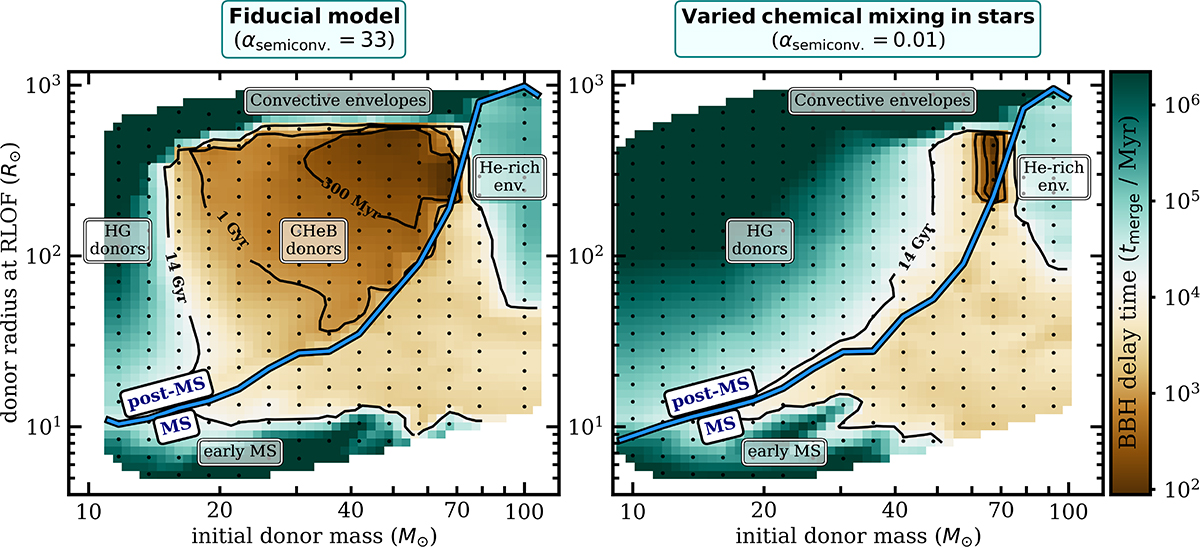
Formation of BBH mergers is a probe of internal chemical mixing in stars and of the stellar structure. We plot the minimum BBH delay times from SMT evolution given the donor mass (at ZAMS) and radius (at RLOF) for two variations in the efficiency of semiconvective mixing in stars (αsemiconv.). Only cases with the BBH delay time below ≲13.7 Gyr (yellow-brown regions) are potential GW sources. The range of donors that may lead to BBH mergers is severely reduced in the variation with low efficiency of semiconvection (right panel) and it shows a preference for high-mass donors (≳40 M⊙). This is because the chemical structure of donor stars determines the conditions for delayed-dynamical instability and therefore affects the critical mass ratios, the minimum post-SMT separations, and BBH delay times (Sect. 4.2). This is different from the assumptions on the orbital AM loss that only affects the qcrit (Fig. 5). The difference between stellar models in both panels is closely connected to the blue supergiant problem (Sect. 4.3). The thick blue line shows the transition from MS to post-MS donors. Several main types of donors are labeled (Hertzsprung gap, core-He burning, convective envelopes, He-rich envelopers); see text. Based on MESA models of BH+O-star binaries evolving through SMT at the critical mass ratio q = qcrit. See Fig. D.2 for post-SMT separations.
Current usage metrics show cumulative count of Article Views (full-text article views including HTML views, PDF and ePub downloads, according to the available data) and Abstracts Views on Vision4Press platform.
Data correspond to usage on the plateform after 2015. The current usage metrics is available 48-96 hours after online publication and is updated daily on week days.
Initial download of the metrics may take a while.