


Fig. 7.
Download original image
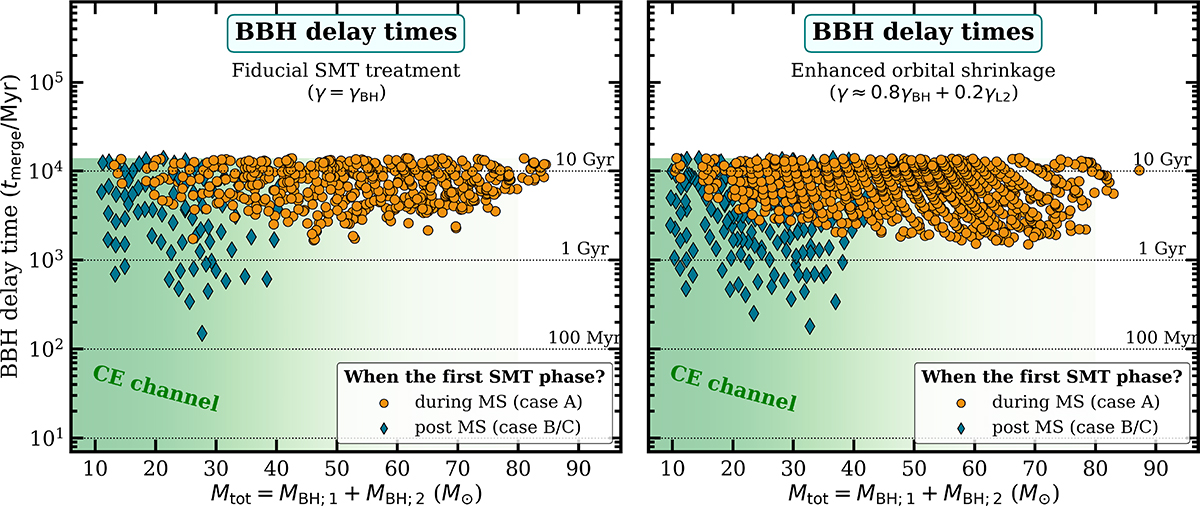
BBH mergers from the SMT channel have long delay times (≳1 Gyr) as a consequence of the fundamental separation limit, regardless of the uncertainties in binary orbit evolution (left vs. right). Here, we plot the delay times of merging BBHs from SMT evolution (tmerge ≲ 13.7 Gyr) from all our binary MESA grids, as a function of the total BBH mass. We distinguish between BBH mergers formed via SMT evolution from MS donors (case A mass transfer) and post-MS donors (case B or C). Notably, case A evolution dominates for massive BBH mergers (≳40 M⊙). Two variations are considered: non-accreted mass ejected with the specific AM of the BH (γ = γBH) and enhanced AM loss due to L2 outflows (γ ≈ 0.8γBH + 0.2γL2). The BBH delay times are unaffected by the choice of γ. The green shading indicates the approximate range of delay times and masses where we expect the CE channel to contribute. The figure is based on MESA binary grids of BH+O-star systems with the firstly formed BH initial mass of MBH; 1 = 4, 7, 10, 13, 16, 20, 24, 28, 32, 36 M⊙, and 40 M⊙ (see Fig. 2 for details and Appendix D for other masses).
Current usage metrics show cumulative count of Article Views (full-text article views including HTML views, PDF and ePub downloads, according to the available data) and Abstracts Views on Vision4Press platform.
Data correspond to usage on the plateform after 2015. The current usage metrics is available 48-96 hours after online publication and is updated daily on week days.
Initial download of the metrics may take a while.