


Fig. 6
Download original image
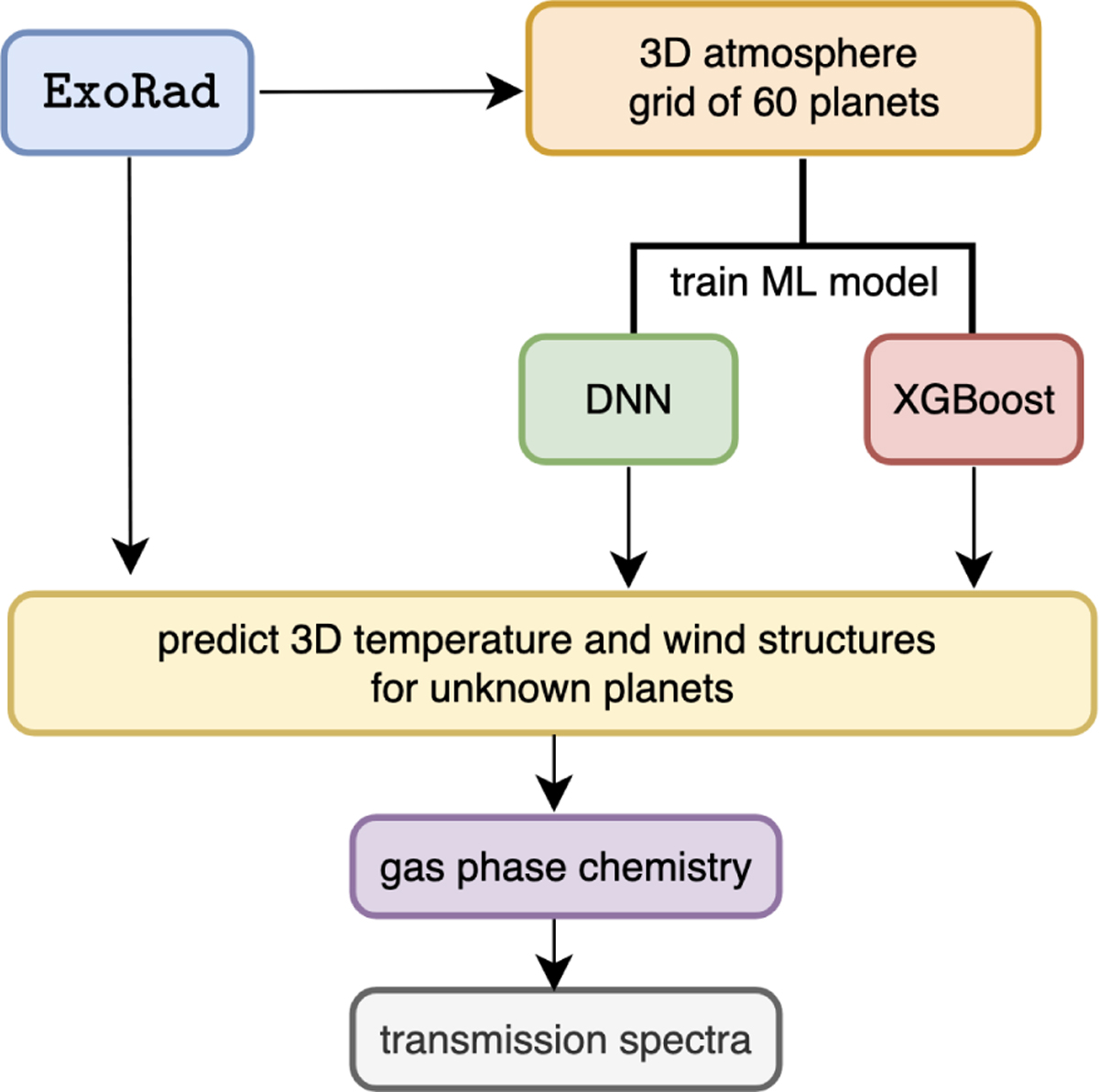
Flowchart to derive ML-accelerated three-dimensional atmosphere models. The ML models (DNN, XGBoost) were trained to predict the gas temperature and wind structure of exoplanetary atmospheres. Step 1: a grid of pre-calculated three-dimensional planetary atmospheres (ExoRad) is used to train ML models. Step 2: the performance of the ML models is evaluated on unseen planets. Their predicted one-dimensional (Tgas, pgas)-profiles are compared to reference ground truth (Tgas, pgas)-profiles (ExoRad). Step 3: to assess how prediction errors propagate, equilibrium gas phase chemistry calculations (GGchem), performed on selected one-dimensional (Tgas, pgas)-profiles, and simulated transmission spectra (petitRADTRANS) are compared.
Current usage metrics show cumulative count of Article Views (full-text article views including HTML views, PDF and ePub downloads, according to the available data) and Abstracts Views on Vision4Press platform.
Data correspond to usage on the plateform after 2015. The current usage metrics is available 48-96 hours after online publication and is updated daily on week days.
Initial download of the metrics may take a while.