


Fig. 1.
Download original image
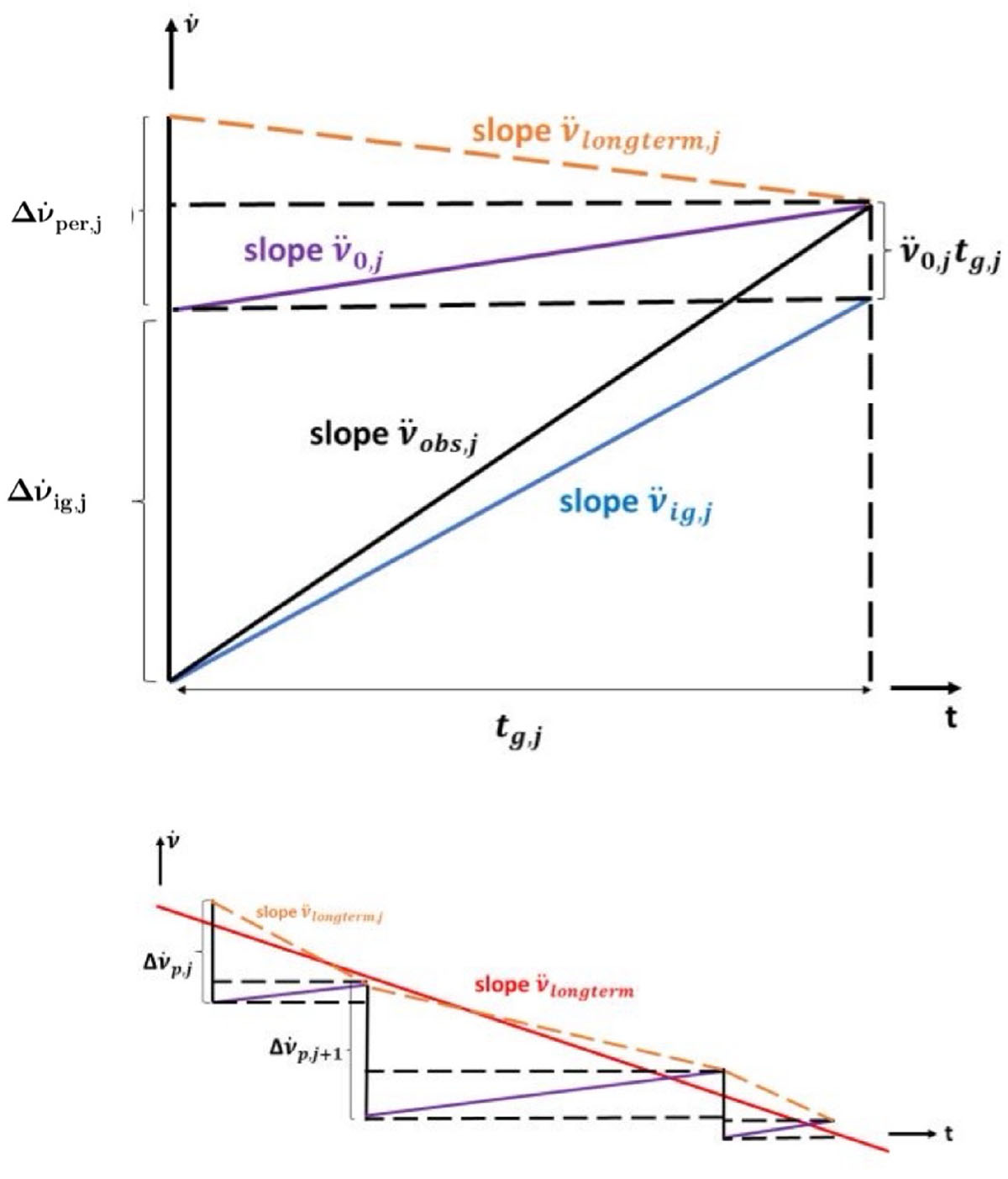
Upper panel: Model for the inter-glitch evolution of  from glitch j to glitch j + 1. The solid black line depicts the observed inter-glitch evolution. Assuming that the recovery of the glitch offset in the internal torque is completed at exactly the time of arrival of the next glitch, the observed glitch step (
 ) in the spin-down rate is the sum of the permanent part (
 ) and the recovering part (
 ) under
  due to the internal torque, as shown in blue. Subtracting the contribution of the internal torque from the total observed
  gives
gives  , the slope of the purple line, due to the external torque. The permanent shift (
 ) is only partially counteracted by an amount
  , as shown by the purple line. The combined effect results in a remaining decrease in
  , with an inferred slope of
  (orange line). Lower panel: Long-term evolution over many glitches, shown in orange. This implies an effective negative
  and a negative effective braking index, given by the slope of the red line.
Current usage metrics show cumulative count of Article Views (full-text article views including HTML views, PDF and ePub downloads, according to the available data) and Abstracts Views on Vision4Press platform.
Data correspond to usage on the plateform after 2015. The current usage metrics is available 48-96 hours after online publication and is updated daily on week days.
Initial download of the metrics may take a while.