


Fig. 4
Download original image
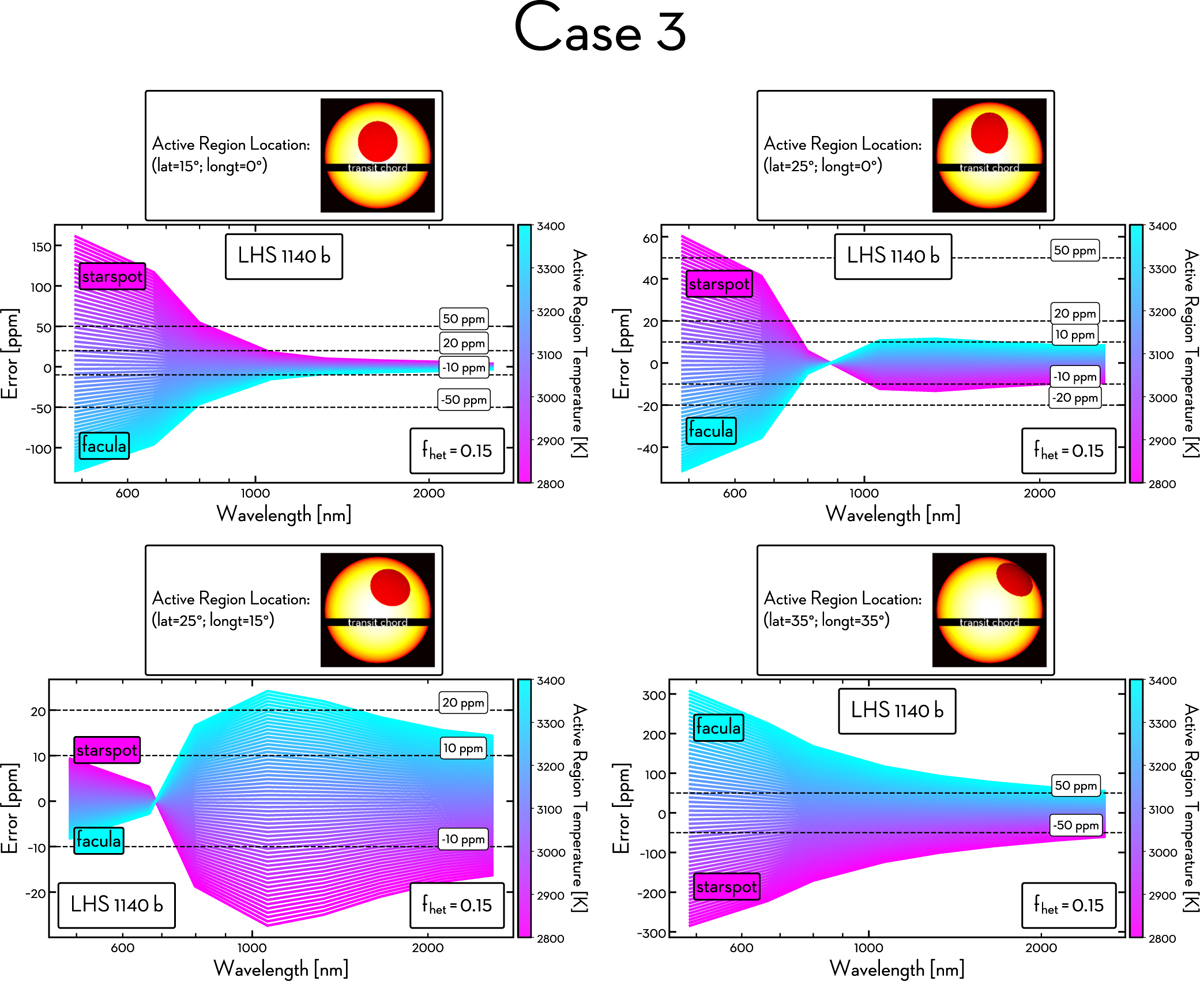
Effect of the active region’s spatial position on the stellar disk for LHS 1140 b, illustrating the wavelength-dependent error between ECLIPSE-Xλ and R-TLSE. Each curve corresponds to a different temperature of the active region (spot or facula). The four panels examine positions gradually shifting from close to disk center (15° latitude, 0° longitude) toward the limb (35° latitude, 35° longitude). A sign inversion emerges at intermediate positions beyond the optical wavelengths (right panel, first row). The lower panels depict more extreme cases with active regions placed even closer to the limb, showing that the sign-inversion boundary moves to shorter wavelengths, significantly altering and reducing errors in the optical regime, while further limb positioning exacerbates R-TLSE inaccuracies due to enhanced limb darkening and foreshortening. Positive errors mean that R-TLSE predicts a shallower transit than ECLIPSE-Xλ (overcorrecting contamination), whereas negative errors mean that R-TLSE predicts a deeper transit (under-correcting contamination).
Current usage metrics show cumulative count of Article Views (full-text article views including HTML views, PDF and ePub downloads, according to the available data) and Abstracts Views on Vision4Press platform.
Data correspond to usage on the plateform after 2015. The current usage metrics is available 48-96 hours after online publication and is updated daily on week days.
Initial download of the metrics may take a while.