


Fig. 1
Download original image
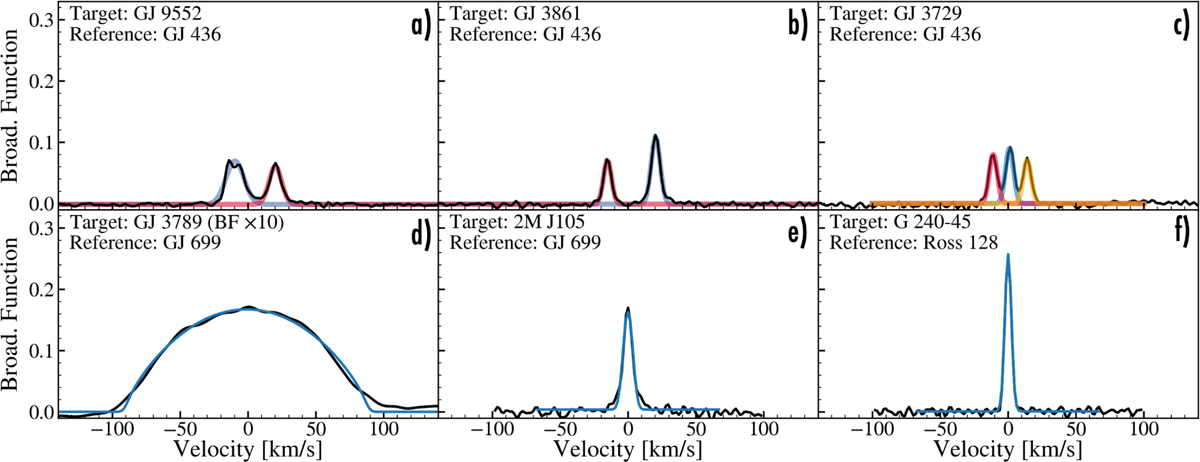
Broadening functions of the targets that showed significant evidence being spectroscopic multiples, i.e., showed evidence of two lines (GJ 3861 and GJ 9552), or three lines (GJ 3729). We additionally show GJ 3789, and G 240-45 which do not show a double line profile in the HPF broadening functions, but are known binary systems with close (<1.7″) companions (Beuzit et al. 2004; El-Badry et al. 2021). Finally, we also show the broadening function of 2MASS J10534129+5253040, which has a high Gaia DR3 RUWE value of 2.4, which we thus assume to be a close visual binary. The blue curves show a best-fit Gaussian to the primary (i.e. brightest) peak, the red curve shows the secondary peak (if any), and the yellow peak highlights a fit to a tertiary peak (if any). The GJ 3789 broadening function is multiplied by a factor of 10 in the y-axis for enhanced readability.
Current usage metrics show cumulative count of Article Views (full-text article views including HTML views, PDF and ePub downloads, according to the available data) and Abstracts Views on Vision4Press platform.
Data correspond to usage on the plateform after 2015. The current usage metrics is available 48-96 hours after online publication and is updated daily on week days.
Initial download of the metrics may take a while.